
How does the organic vapor recovery membrane separate oil and gas from air? Direct answer: by "dissolution diffusion" mechanism-the solubility and diffusion rate of organic molecules in the mixed gas in the membrane material are higher than those of nitrogen and oxygen, so the organic components are preferentially enriched on the permeation side through the membrane layer, and the air components are trapped on the interception side and discharged. The whole process has no phase change, no heating, no medicine, is a pure physical screening. The principle is finished in one sentence, but to make good use of this mechanism, we must find out three things: driving force, membrane material and process configuration. This article thoroughly explains the principles by focusing on these three matters.
The driving force of membrane separation is the partial pressure difference between the two sides of the membrane: the partial pressure of organic components on the intake side is high, and the partial pressure of organic components on the permeation side is pumped by a vacuum pump, and molecules flow from the high pressure side to the low pressure side. The higher the vacuum degree on the permeation side, the higher the inlet concentration, and the greater the permeation. This is why the membrane device is always equipped with a vacuum pump, and the economy of the membrane will decrease under low concentration conditions. The commonly used circulation loop in the project makes up for: the enriched gas on the permeable side returns to the front end for condensation or the compressed inlet for circulating enrichment, and the purified gas on the interception side is discharged up to the standard, so that the "small partial pressure difference" accumulates into a considerable recovery amount in the circulation.
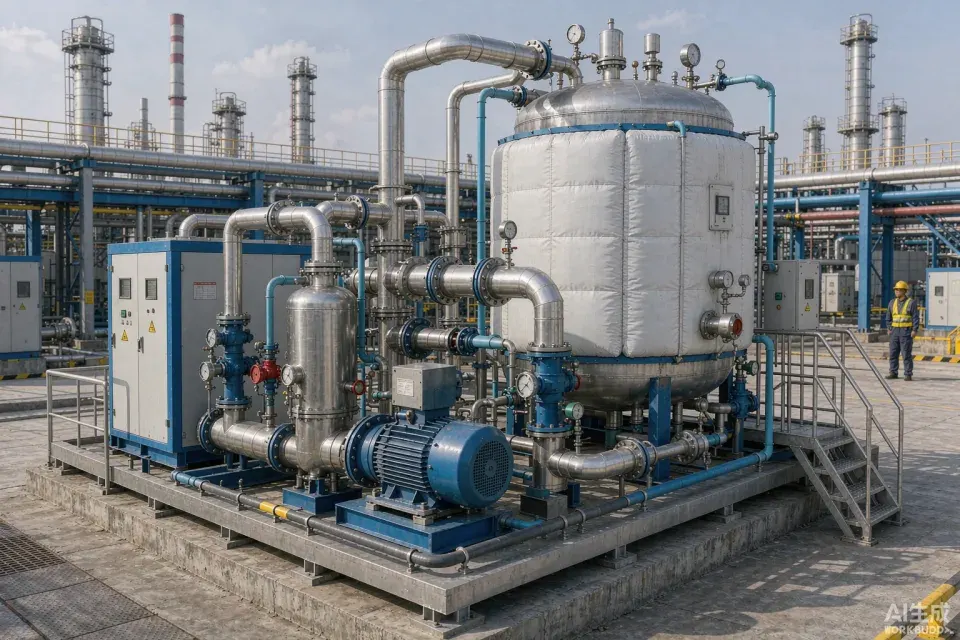
Organic vapor recovery is represented by rubber polymer membranes-polydimethylsiloxane: these materials have flexible molecular chain segments, large free volume, strong solubility for organic molecules, and oil and gas/air separation factors that can reach tens of times. However, the glassy membrane takes another route, which is common in gas hard separation scenes. The two materials are different from the selection direction and are not mixed when selecting. The weakness of the rubbery membrane is also clear: it is sensitive to droplets, particles and high humidity in the feed, and must be equipped with defogging and filtration pretreatment before the membrane; Some active components have swelling risks to the membrane material, and special media should be tested for compatibility before engineering.
The membrane section usually does not fight alone in the recovery system: the role of the membrane is "concentrator"-concentrating the low-concentration tail gas five to ten times, and the concentrated gas is liquefied and recycled in the condensation section. The small air volume and high-concentration gas after membrane concentration reduces the condensation scale and energy consumption simultaneously, which is why the comprehensive energy consumption of the condensation and membrane combination can be reduced to the 1/3 to 1/2 of the condensation alone. In the structure of the membrane module, the hollow fiber type has a large specific surface area and a high loading density, which is the mainstream configuration for tail gas recovery. The parallel connection of the module can be expanded according to the gas volume, and the maintenance is rotated according to the module, which does not affect the operation of the whole line.
Give the selector a judgment caliber: high intake air concentration, recovery value, membrane is a good helper; When the concentration is so low that recovery is unprofitable, the membrane section is idling when installed. Before selection, test the working conditions and let the data decide whether to use membrane and how much membrane to match.
| key points | Content | Engineering significance |
|---|---|---|
| separation mechanism | dissolution diffusion physical sieving | No phase transformation without heating |
| Driving force | partial pressure difference on both sides of the membrane | Vacuum pump configuration basis |
| membrane material | rubbery polymer membrane | organic molecules preferentially through |
| separation factor | Oil and gas to air dozens of times | Concentrate five to ten times |
| Process Role | Concentrator | Small air volume cross condensation recovery |
| Preprocessing | defogging filtration | The premise of the life of the protective film |
Permeability, but the rate difference is very large-the permeation rate of organic molecules is dozens of times that of air, so the permeation side is enriched with oil and gas, and the interception side is discharged with purified gas. Separation is established by this rate difference.
Under the low concentration feed, it is usually difficult to directly meet the strict limit by relying on the primary membrane alone; the project is mainly based on the combination of condensation and membrane, with the membrane responsible for concentration and condensation responsible for liquefaction, each performing its own duties.
Yes. Pollutant plugging and swelling will reduce the flux, which is manifested as an increase in the pressure difference before the membrane; pretreatment in place and periodic cleaning, performance can be maintained at the design level for a long time.
This article by LuoyangWohong PetrochemicalEquipment Co., Ltd. arranges that the company provides design, manufacturing and operation and maintenance services for condensation recovery, membrane separation recovery and complete solvent recovery devices for chemical and pharmaceutical enterprises. If you need process evaluation or scheme configuration, please contact and exchange.
Mr. Li 13526990215

Hotline





