
Direct answer:The core of VOCs organic solvent liquefaction recovery device is the coordination of "condenser tube recovery and membrane tube bottom-up": the compression unit first lifts the partial pressure of organic vapor in the waste gas, the multi-stage condensation unit stepwise cools down the temperature according to the boiling point of the solvent to directly liquefy most of the vapor into liquid for recovery, and the membrane separation unit then enriches the low-concentration tail gas that cannot be condensed-the enriched gas returns to recycle and the purified gas meets the discharge standard. Four units in series, the whole physical process.
\n\nEach waste gas production point is connected to the device through the closed negative pressure pipe network, and the pretreatment unit removes the droplets, aerosols and free moisture entrained by the airflow. This step protects the back-end condenser and membrane module from blockage, pollution and corrosion, which is the premise of long-term stable operation of the device.
\nThe efficiency of condensation recovery depends on the organic vapor partial pressure. After the compression unit increases the partial pressure of the exhaust gas, more solvent vapor will reach saturation and liquefy at the same low temperature-this is also the key to the "recovery" of high-concentration exhaust gas: the higher the concentration, the higher the condensation recovery rate.
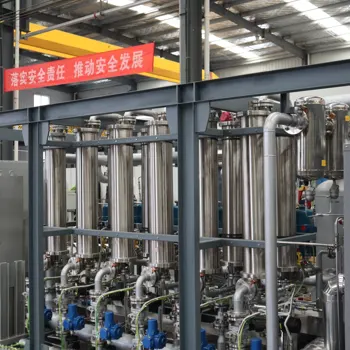
Different solvents have different boiling points, and multi-stage condensation is gradually cooled according to the temperature gradient: high boiling point components are precipitated first, and low boiling point components are liquefied at a lower temperature level. The liquid solvent is collected and purified by water separation and precision filtration. The quality meets the production reuse standard and is directly reused in the workshop.
\nAfter condensation, the residual low-concentration tail gas enters the polymer membrane module, and VOCs is enriched to the permeation side by using the selective permeation characteristics of the membrane material to organic molecules: the enriched high-concentration mixed gas is returned to the compression section for recycling, and the purified tail gas meets the discharge standard. Membrane separation complements the short board of single condensation in the low concentration section.
\nThe high concentration section relies on condensation to recover the income, and the low concentration section relies on membrane separation to ensure the standard discharge. The junction of the two sections is opened by the compression unit, and the whole machine is uniformly dispatched by PLC automatic control, which is suitable for continuous production and intermittent pulse conditions.
\nQ: Why not single condensation in the end?
A: Due to the limitation of steam partial pressure, the single condensation recovery of low-concentration tail gas is insufficient. Membrane separation just makes up for this section.
Q: Is there a chemical reaction?
A: No. Collection, compression, condensation and membrane separation are all physical processes without secondary pollution.
LuoyangWohong PetrochemicalEquipment Co., Ltd. provides the design and manufacture of the complete set of liquefaction recovery unit for condensing membrane separation. Welcome to consult the process plan.
Mr. Li 13526990215

Hotline





