Why do three oil and gas recovery equipment need buffer tanks? Direct answer: The exhaust of gas stations and oil depots is pulsed - when the crane is opened, the gas phase of the tanker truck is pushed out, and the load instantly increases. The peak value is even greater when several vehicles are operating simultaneously; The buffer tank uses its own volume to peak and valley this pulse, ensuring stable gas flow and concentration for condensation, adsorption, and membrane separation at the rear end, so that the process section can run stably according to the design conditions. Without a buffer tank, the pulse load directly impacts the backend, causing fluctuations in recovery efficiency, frequent start stop of equipment, and shortened lifespan. The judgment criteria are based on the peak valley difference and the number of simultaneous operations. The larger the peak valley difference, the more suitable the equipment should be. This article explains the configuration logic and capacity verification clearly. Many sites have saved buffer tanks, resulting in the backend always chasing load and the equipment being blamed for the poor recovery rate.
The exhaust of loading and refueling is naturally pulsed: when a single crane is operating, the displacement rushes from zero to peak and then returns to zero over time. When multiple cranes are operating off peak, the total load is the superposition of several pulses, and the instantaneous peak may be several times higher than the average. This type of load enters the back-end process, where the condensing unit needs to cool at peak, the membrane module needs to separate at peak, and the adsorption bed needs to penetrate at peak. If all are designed according to peak values, they will be severely idle, and if they are designed according to average values, they will collapse at peak values. The buffer tank aims to solve the contradiction that is not suitable for anyone's design.
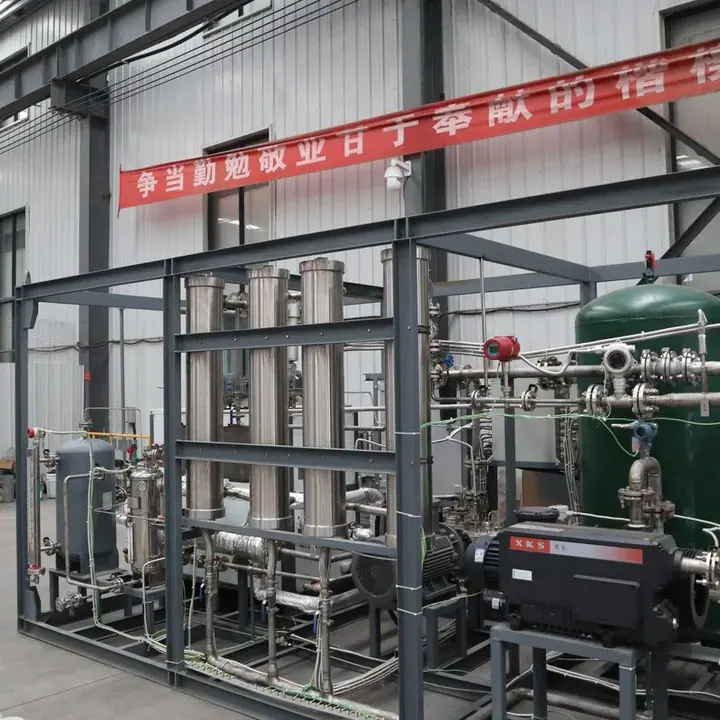
The buffer tank is essentially a container for temporarily storing gas volume: excess gas is stored in the tank during peak periods, and the gas inside the tank is replenished during valley periods, with the outlet flow rate flattened. Supporting voltage stabilization and current limiting to ensure that the intake flow rate of the back-end process section remains stable within the designable range. The capacity of the buffer tank in the configuration is determined based on the peak duration and peak valley difference, rather than the larger the capacity, the more suitable it is - too much land occupation and cost increase, too small cannot cut the peak. The maximum simultaneous workload after the convergence of the main pipelines should be included in the calculation of multiple crane stations, not just based on a single unit.
Smooth intake directly benefits three aspects: the condensing section is no longer overheated due to instantaneous high flow, and the cooling load can be expected; The adsorption section no longer frequently penetrates due to pulses, and the lifespan and outlet concentration of the carbon layer are more stable; The membrane segment no longer experiences pressure fluctuations due to sudden changes in concentration, membrane fouling is controllable, and the recovery rate is stable. The buffer tank also reduces the number of starts and stops of the equipment, reduces the useless work of the vacuum pump and compressor, and synchronously reduces energy consumption and wear. It is the cornerstone of the entire system's stability, not an optional accessory.
The input for capacity verification is three items: peak flow rate and duration of a single unit, number of simultaneous operations and superimposed peak, and acceptable flow fluctuation range of the backend process. First, use the peak curve to accumulate the excess gas volume. The buffer tank capacity is determined based on the ability to temporarily store this excess and release it smoothly, and then leave a safety margin. When changing seasons or expanding crane positions, recalculate and do not continue to use the original version. The inlet and outlet of the buffer tank and the flow limiting valve should be selected according to the maximum flow rate, and should not get stuck at the bottleneck.
| Attention Items | No buffer tank | Equipped with buffer tank | Description |
|---|---|---|---|
| intake flow | Intense pulse | Stable and designable | peak shaving and valley filling |
| Condensation load | Peak surge | predictable | Stable cooling |
| Adsorption penetration | frequently | Reduce | Carbon has a long lifespan |
| Membrane pressure difference | high volatility | Stability | Pollution is controllable |
| Equipment start-stop | frequently | Reduce | Energy consumption and wear reduction |
| Capacity verification | Idle according to peak value | According to the excess gas volume | Leave a margin |
No: too much land occupation and rising costs, too small to reduce peak shaving; Determine the volume based on the peak excess gas volume and leave a margin. When expanding multiple crane positions, recalculate and do not leave it unchanged.
Observing peak valley difference: For stations with a single crane position and sparse operations, the peak value is not obvious, and a small buffer can be added; For those with multiple crane positions or intensive operations, the pulse superposition is obvious, and the stable benefits of the buffer tank are very direct.
It will involve: it is a pressure vessel, and the inlet and outlet flow restriction and explosion prevention are configured according to regulations. The gas group and area division should be covered; The buffer tank itself is also an inspection item, don't relax safety requirements just because it's just a tank.
This article by LuoyangWohong PetrochemicalEquipment Co., Ltd. arranges that the company provides design, manufacturing and operation and maintenance services for condensation recovery, membrane separation recovery and complete solvent recovery devices for chemical and pharmaceutical enterprises. If you need process evaluation or scheme configuration, please contact and exchange.
Mr. Li 13526990215

Hotline