
How to dehydrate the recovered mixed solvent? According to the water content and reuse requirements, it is divided into three grades: the condensate which is immiscible with water and contains less water can be solved by standing and layering; the water content requires strict supplementary adsorption and drying; the water is miscible or the water content is high and the purity is high. The three methods are not substitutes for each other, but are used in combination according to the working conditions. The selection is based on the composition of the condensate, the water content state and the reuse standard.
There are three main sources: the water vapor carried by the tail gas condenses together when condensing; The free water brought in by cleaning and water washing processes; Part of the solvent itself absorbs moisture and slowly increases water during storage. The water content and the complexity of the components directly determine the dehydration route, so first take samples and test, find out the components and moisture of the condensate, and then talk about the plan.
Solvent condensate immiscible with water can be separated by standing or equipped with a coalescing separator. The cost is low and the operation is simple. Most ester, alkane and chlorinated hydrocarbon condensate can go this way. Its limitation is that it can only remove free water, and the part of the solvent dissolved in the water is also taken away with the water phase. When the condensate itself is dissolved in water, this method fails.
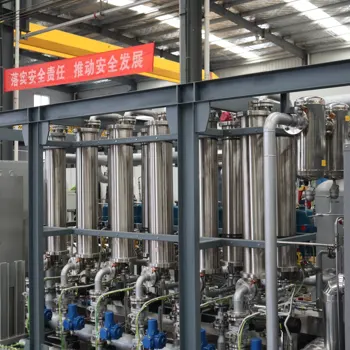
The residual dissolved water after layering, or reuse occasions with strict requirements on water content, is checked by adsorption and drying: the solvent flows through the desiccant bed, the water content is adsorbed, and the water content of the discharge can be reduced to a very low level. Operating costs are mainly desiccant replacement and regeneration energy consumption, solvent through a large amount of occasions to account for consumables cycle, generally as a finishing section after layering, do not carry a large amount of water alone.
| comparison dimension | Layered static | adsorption drying | distillation dewatering |
|---|---|---|---|
| Applicable condensate | Insoluble in water, mainly free water | Residual dissolved water after delamination | Water mutual solubility or high water content |
| Dehydration depth | except free water | deep drying | It can be made very deep according to the tower working condition. |
| Main cost | Low, standing time with separator maintenance | Desiccant replacement and regeneration | Energy consumption of heat source and tower system |
| Typical Usage | Layered bottoming, adsorption or rectification according to the standard string of reuse | ||
It is related to the density difference and viscosity of condensate, and there is no unified value. The actual operation shall be subject to the stability of the interface and the clearing of the water outlet. Varieties with small density difference and large viscosity shall be appropriately prolonged or equipped with coalescence separator.
Depending on the solvent throughput and the water content in the feed, the penetration point shall be judged through the discharge moisture monitoring during operation, and replacement or regeneration shall be arranged when the penetration is close. It is not recommended to perform hard discharge according to a fixed number of days.
The water content standard is only one of the indicators, and whether the proportion of components meets the use requirements should also be checked. If there is a large gap, it needs to be refined and allocated, which is determined according to the test data and process requirements.
LuoyangWohong PetrochemicalEquipment Co., Ltd. provides scheme design, equipment manufacturing and operation debugging services for recycling solvent dehydration and refining unit. Welcome to contact and exchange.
This article is organized by Luoyang wohong petrochemical equipment co., ltd. if you need to evaluate the dehydration scheme of solvent recovery or on-site investigation, please contact and exchange.
Mr. Li 13526990215

Hotline





