
In the VOCs organic solvent liquefaction recovery system, the condensation temperature is the core parameter to determine the recovery rate and operating energy consumption. If the temperature is set too low, the refrigeration energy consumption and frosting risk will go up. If it is set too high, the solvent residue in the tail gas will not come down. In engineering, a single temperature is usually not used, but graded condensation is used to combine different temperature levels to find a balance between recovery rate and energy consumption. The following describes the selection basis of the condensing temperature and the idea of the series arrangement.
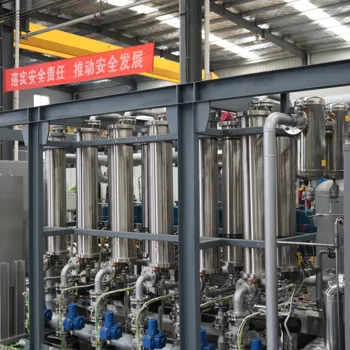
The number of stages increases and the recovery rate increases, but the refrigeration work required for each temperature drop is increasing. This is also why the engineering seldom relies solely on cryogenic pursuit of extreme recovery, but after cryogenic membrane separation: a relatively economical membrane unit is used to enrich the residual solvent back to the front end, so that the cryogenic section does not have to be too deep, and the overall energy consumption is more reasonable.
| Design Objectives | Series arrangement | Description |
|---|---|---|
| Mainly in the recovery of solvent | Precool Main Condenser | The condensate reuse value is high, the number of sections is small, and the operation is economical. |
| Recycling and compliance | Pre-cooling main condensation deep cooling | The end temperature level is determined according to the discharge requirements. |
| Low concentration and large air volume | precooled condensing membrane separation | Enrichment by membrane unit to avoid high cryogenic energy consumption |
| wet high boiling point system | enhanced precooling two-stage condensation | Pre-cooling section takes on main dehumidification function |
Q: Can I cover all solvents with one uniform temperature?
Answer: Not recommended. The saturated vapor pressure of different solvents varies greatly, and the unified temperature level is either insufficient to recover or waste energy consumption, which should be calculated according to the system.
Q: Do I have to go to the deep cold section?
A: It depends on the target recovery rate and emission requirements. If the solvent reuse is the main purpose and the emission requirements are conventional, the two-stage condensation and membrane separation can often be met.
Q: How to solve the problem of frost?
Answer: The core is the pre-cooling dehumidification and heat exchanger switching design. The water is removed from the front end, and the cryogenic section is operated alternately in two ways, which can defrost without stopping the machine.
Q: How much more expensive is graded condensation than single-grade?
Answer: It depends on the series and the form of cold source. It cannot be generalized. The increase in investment in the classification scheme is usually recovered in terms of operating energy consumption and recovery income, which needs to be accounted for on a project basis.
LuoyangWohong PetrochemicalEquipment Co., Ltd. is engaged in the design and manufacture of condensation and membrane separation solvent liquefaction recovery system, which can be calculated according to the actual working conditions. Welcome to contact the exchange.
Mr. Li 13526990215

Hotline





