
Condenser is the key equipment to determine the recovery rate in the solvent recovery unit. Three things should be clearly calculated when selecting the type: how much heat exchange area is needed, whether the cooling capacity matches the load, and whether the low temperature section will be frosted and blocked. Many on-site recovery effects are not ideal. The problem is not that the capacity of the refrigerator is not enough, but that the heat exchange area is estimated to be too small according to experience, or there is no graded condensation, resulting in the outlet running away with liquid and steam as soon as the air intake is high.
First determine the amount of steam to be condensed and the target recovery rate, and calculate the heat to be removed; Then determine the heat transfer temperature difference-the area can be small if the temperature difference is large, but the energy consumption and frosting risk increase; Then estimate the area according to the heat transfer coefficient of the selected heat exchanger form, and leave a margin for ash deposition, scaling and working condition fluctuations. The larger the area, the better. If it is too large, it will bring unnecessary investment and cold loss.
The most problematic thing in the calculation is the amount of steam. Many schemes directly take the air volume of the equipment nameplate as the processing capacity, but the actual exhaust volume is very different between the heating stage and the heat preservation stage. According to the low value of the heat preservation stage, the heating stage will inevitably fail.
The steam load varies with the feed volume, heating rate and exhaust temperature of the production batch, and the peak value is often higher than the average value. If the refrigeration unit is selected according to the average value, the outlet temperature will not be able to be pressed when the peak value comes.
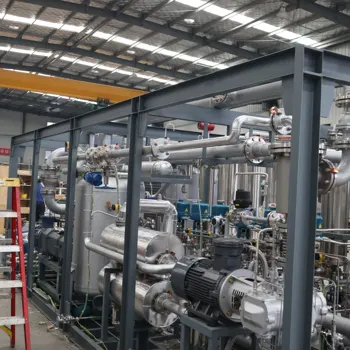
The feasible method is to set up buffer or classification: use the pre-cooling section to cut the peak and stabilize the end condensation section at a lower temperature; The refrigeration unit is configured according to the peak demand, or the cold storage is used to reserve the cold during the low load period. The two methods have their own applications. The key point is not to miss the peak load.
The advantage of grading is that the temperature level of each section can be set independently, and the moisture and non-condensing components can be treated separately.
| Rank | Function | Common practices |
|---|---|---|
| Pre-cooling section | Heat exchange with recovered cold air to reduce peak load | Gas-gas heat exchange, reduce refrigeration load |
| Medium temperature section | Condensation of most of the solvent vapor | Adopt conventional refrigerant temperature level |
| Low temperature section | Improve the recovery rate and depress the export concentration. | Lower refrigerant temperature level, frost prevention should be considered |
| Anti-frost measures | Prevent ice blockage and channel blockage | Pre-dewatering of intake air, alternate defrosting or set up spare channel |
| Drainage | Discharge condensate in time to avoid backflow occupying heat exchange surface | Independent discharge of each section and set up liquid level control |
Not necessarily. The area should be calculated according to the heat transfer temperature difference and actual load. If the area is too large, the investment and cooling loss will be increased. The upper limit of recovery depends primarily on the lowest condensation temperature and vapor partial pressure that can be achieved.
For a single solvent, gas stability of the occasion, single-stage condensation can also meet the requirements. When the exhaust gas contains a variety of solvents, contains water or has large load fluctuation, graded condensation is more secure: it can not only cut the peak, but also allow the water to precipitate first at a higher temperature to avoid frosting in the low temperature section.
The common reason is that the heat transfer area is dirt, dust or frosting, which reduces the actual heat transfer coefficient; it may also be that the drainage is not smooth and the condensate reflux occupies the heat transfer area. Regular inspection of cleaning and drainage, most problems can be found in advance.
This article by LuoyangWohong PetrochemicalEquipment Co., Ltd. arranges that the company provides design, manufacturing and operation and maintenance services for condensation recovery, membrane separation recovery and complete solvent recovery devices for chemical and pharmaceutical enterprises. If you need process evaluation or scheme configuration, please contact and exchange.
Mr. Li 13526990215

Hotline





