
activated charcoalAdsorption is the most common check section in the solvent recovery unit: the low-concentration tail gas enters the condensation section to collect the unclean residual solvent and ends up by the adsorption tower. The adsorption tower is well managed and the discharge of the control section is stable for a long time. The pipe is not good, the penetration comes early, the desorption is not complete, and the emission data fluctuates. Adsorption tower management around three things: regeneration cycle, desorption effect and safety protection.
Most of the problems of adsorption towers have processes: incomplete regeneration leads to gradual attenuation of available capacity, advance of penetration point, and emission rise before being detected. The management is done on a daily basis, the attenuation can be seen on the data, and the processing is arranged to be completed in the planning window.
The regeneration cycle is not one-size-fits-all according to a fixed number of days, but is determined according to two bases: adsorption capacity accounting-intake air volume and concentration to calculate the single-cycle adsorption load, and the theoretical cycle is obtained by comparing the available capacity of carbon loading; Operating data correction-the point in time when the outlet concentration is close to the penetration threshold is the upper limit of the actual cycle. The theoretical cycle is used as a benchmark, the measured penetration is corrected, the periodic table is reviewed quarterly, and the intake structure changes immediately.
The multi-tower rotation device incorporates the maintenance of the switching valve into the cycle management: the leakage in the valve will allow the regeneration tower to continue to feed air, and the two processes of regeneration and adsorption interfere with each other, showing that the cycles of the two towers are chaotic. The sealing inspection and action test of the valve are done on a monthly basis, and the switching abnormality is easily seen in the data.
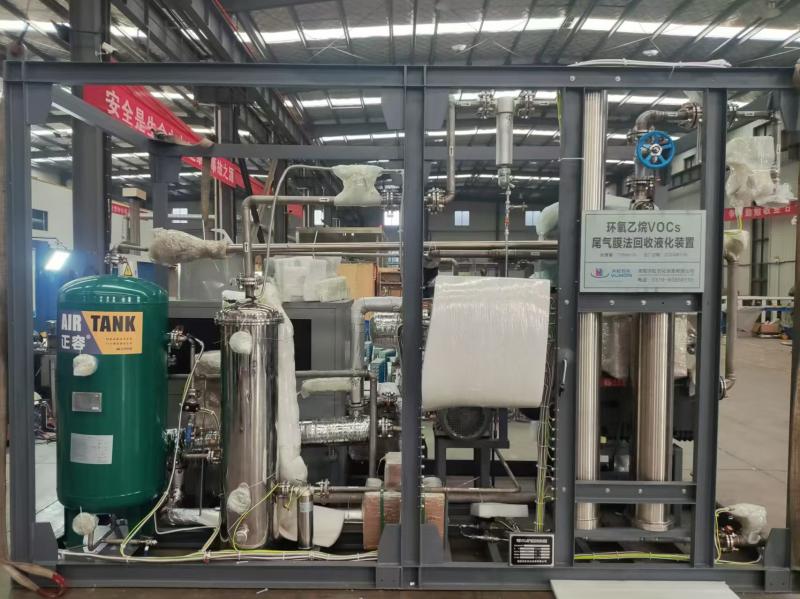
Whether the desorption is completely depends on three numbers: whether the desorption temperature and time meet the requirements of the scheme, whether the concentration curve of the desorption effluent is complete, and whether the residual load of the tower after regeneration returns to the reference. For regeneration with insufficient temperature or steam, the outflow curve is short and flat. In fact, a large amount of solvent remains in the bed, and the adsorption capacity in the next cycle is discounted. The regeneration curve is recorded one by one, and compared with the benchmark, the attenuation trend is detected early and intervened early.
The life of the carbon itself should also be managed: after repeated regeneration, the pore volume attenuation, strength decline, pressure difference increase and adsorption capacity decline simultaneously. The amount of carbon, carbon age, replacement records to build a ledger, according to the test results to arrange screening supplement or overall replacement, not until the penetration exceeds the standard.
| Phenomenon | Common causes | Handling method |
|---|---|---|
| Penetration in advance | Regeneration is not complete | Check temperature time and steam quantity |
| emission fluctuation | Internal leakage of switching valve | Valve inspection and action test |
| bed temperature rise | Ultra-high concentration into the tower | Condensation and depressurization before entering the tower |
| Differential pressure rise | Carbon powder dust blockage | Blow back or sieving carbon supplement |
| Capacity degradation | Pore volume attenuation due to carbon age | Replace as per inspection arrangement |
| Odor after shutdown | solvent reinfiltration | Empty bed load in front row of shutdown |
The core of adsorption safety is the control of adsorption heat: high-concentration intake air directly enters the carbon bed, heat release accumulation has the risk of temperature rise, the concentration of the inlet tower is controlled according to the upper limit of the scheme, and the overlimit is condensed and depressurized before entering the tower. The bed temperature measuring points shall be configured according to the design, the alarm value shall be monitored shift by shift, and the disposal action of high temperature alarm shall be written into the operation specification. Bed management during shutdown is equally important: empty bed load in front of long-term shutdown to avoid heat accumulation and solvent backosmosis in static state.
Look at the desorption outflow curve and the residual load after regeneration: the curve is complete and the residual returns to the benchmark, and this round of regeneration counts. Just look at the time without looking at the regeneration of the data, the attenuation will be manifested in the way of penetration advance after two or three cycles.
There is no unified answer, depending on the regeneration mode and load intensity. Use two indicators to speak: the detection result of adsorption capacity and the pressure difference trend, either of which will be replaced if it crosses the threshold, and the carbon age on the ledger will be used as a reference.
Check three points in sequence: whether the concentration in the tower exceeds the upper limit, whether there is internal leakage in the switching valve, and whether the previous round of regeneration is in place. Most of the sudden uplift falls in these three places, and the life of the carbon itself is considered after the elimination of each item.
This article by LuoyangWohong PetrochemicalEquipment Co., Ltd. arranges that the company provides design, manufacturing and operation and maintenance services for condensation recovery, membrane separation recovery and complete solvent recovery devices for chemical and pharmaceutical enterprises. If you need process evaluation or scheme configuration, please contact and exchange.
Mr. Li 13526990215

Hotline





