
Xylene often appears in the tail gas of coating and resin industry in the form of mixed aromatic hydrocarbons with ethylbenzene and toluene. The boiling point range is 138 to 144 ℃. At normal temperature, the vapor pressure is low and the temperature requirements for condensation recovery are loose. The difficulty in the recovery of mixed aromatics lies not in condensation itself, but in component management and moisture control: whether the condensate is directly reused in layers or mixed with it, depending on the index requirements of downstream products; The prevention and control of incoming gas with water determines the quality of condensate and the load of the control section.
The main structure of the recovery route is the combination of condensation and membrane separation: high-concentration tail gas primary condensation main recovery, low-concentration tail gas and condensed unclean residue by membrane separation or adsorption control, the load distribution of the two roads according to the concentration of the measured distribution, not according to the estimation of clapboard.
The component management of mixed aromatics starts from the source: the corresponding relationship between incoming batches and workshop scheduling is recorded, and after the law of tail gas concentration changing with the product structure is found out, the condensation temperature level and the feed point of the membrane are fine-tuned according to the actual distribution. The more complete the component data is accumulated, the more accurate the mixing ratio of the recovery liquid adjustment window is, and the quality fluctuation is naturally narrowed.
The vapor pressure characteristics of xylene allow most of the solvent to be recovered by primary condensation: the temperature can be met in the frozen water range, the condensate is placed in the stratification tank, the aromatic phase is automatically separated from the water phase, and the aromatic phase is transferred to the storage tank for reuse after filtration and detection. The condensate of mixed components is tested for distillation range and purity according to batches, and the downstream working conditions sensitive to components are mixed and adjusted, and the recovered liquid is transferred back to the target window for reuse, and the quality management falls on the batch ledger.
The respiratory discharge in the storage link is connected to the recovery system: if the respiratory port of the aromatic hydrocarbon storage tank is not taken over, the storage link becomes a new discharge point, and this account cannot be leaked in the material balance calculation. The turnover plan is linked to the production, and the recovered liquid is reused in batches, which will be determined after the overdue re-inspection.
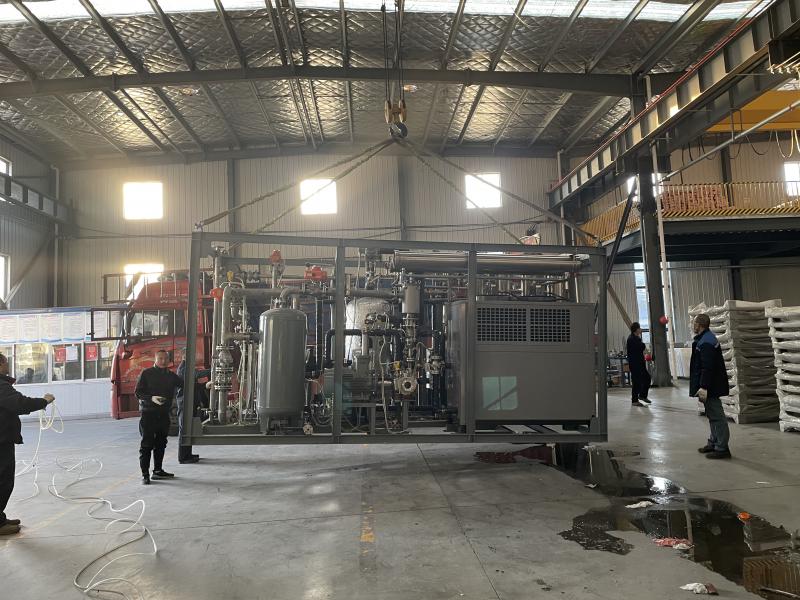
The low-concentration tail gas has large air volume and low concentration, and the income of the condensation section is decreasing. This section is handed over to membrane separation: organic vapor preferentially passes through the membrane, and the permeation side is enriched back to the condensation section and then recovered, and the purified gas on the interception side meets the discharge standard. The advantages of membrane separation are no phase change, low energy consumption, no pressure to replace consumables, and maintenance is concentrated on the filter and differential pressure monitoring. The feed concentration of the membrane has an upper limit, the high concentration condition is pre-condensed to reduce the burden, and the combination sequence cannot be reversed.
The operation monitoring of the control section depends on two items: the pressure difference between the front and rear of the membrane and the concentration at the discharge outlet, the pressure difference rise check the filter, and the concentration rise check the membrane module and the upstream load fluctuation. The two groups of data are recorded by shift, and the abnormal trend is intervened in advance, and the stability of the gate section is maintained by daily data management.
| Segment | Features | Configuration Schedule |
|---|---|---|
| high concentration tail gas | Vapor low and easy to condense | Primary condensation main recovery |
| low concentration tail gas | Large air volume and low concentration | Membrane separation check |
| Layered tank | Automatic stratification of aromatic aqueous phase | Record the standing time by shift |
| aromatic hydrocarbon phase | Mixing components | Detect distillation range doping reuse. |
| Storage Turnover | respiratory discharge | Breathing port access recovery |
| membrane module | Differential pressure monitoring | Filter check and change |
Scenarios: For solvents, there are window requirements for distillation range and purity, and blending and adjustment shall be carried out according to batch detection. The requirements for fuel or auxiliary agent are relaxed and directly reused after detection. The destination of the recovered liquid is determined at the scheme stage, and the configuration follows the purpose.
The life of the membrane is strongly related to the cleanliness of the feed: the membrane module can be used for several years under the condition of pre-filtration in place and no droplets and particles entering; The impact and pollution of droplets will make the performance decay rapidly. The focus of maintenance is not on the membrane itself, filtration and demisting at the front end.
According to the measured concentration distribution, the recovery yield of condensation in the high concentration section is the highest, and the incremental yield of condensation decreases after the concentration drops to a certain level, and this turning point is the feed point of the membrane. The device shall be measured and calibrated during commissioning, and fine-tuned according to the load change during operation.
This article by LuoyangWohong PetrochemicalEquipment Co., Ltd. arranges that the company provides design, manufacturing and operation and maintenance services for condensation recovery, membrane separation recovery and complete solvent recovery devices for chemical and pharmaceutical enterprises. If you need process evaluation or scheme configuration, please contact and exchange.
Mr. Li 13526990215

Hotline





