
What is the difference between isothermal compression and ordinary compression? Direct answer: Ordinary compression is similar to adiabatic process, the heat converted from compression work cannot be dissipated, the gas outlet temperature rises sharply, and the higher the pressure ratio, the harder it rises; isothermal compression takes the heat while compressing, and the outlet temperature is close to the intake air temperature, which benefits both compressor efficiency and medium safety. Isothermal compression is commonly used in solvent recovery. The root cause is that solvent vapor is afraid of heat-too high a temperature rise will lead to coking and polymerization of components, and carbon deposits inside the compressor will also lead to efficiency attenuation and potential safety hazards. Isothermal compression uses liquid injection or spray cooling to take away the heat of compression in real time, which is mature in process and controllable in maintenance. This paper makes clear the difference between the two and the way they are implemented.
Adiabatic compression account: almost all the compression work becomes the internal energy of the gas. The pressure ratio of the outlet temperature increases exponentially, the pressure ratio is 3 to 1, and it is common for the temperature to rise by hundreds of degrees Celsius. The high-temperature gas has to cool down first in the latter section, and the electricity burned in front is equivalent to half wasted. Isothermal compression of the account: the compression process of liquid injection or heat transfer surface synchronous take away heat, the outlet temperature rise control within a few tens of degrees, after the smooth connection, the power consumption per unit of processing capacity will be reduced. The choice of the two is not absolute-ordinary compression is sufficient for media such as air and nitrogen that are not afraid of heat. For working conditions containing solvent and afraid of coking, isothermal temperature is a must rather than an option.
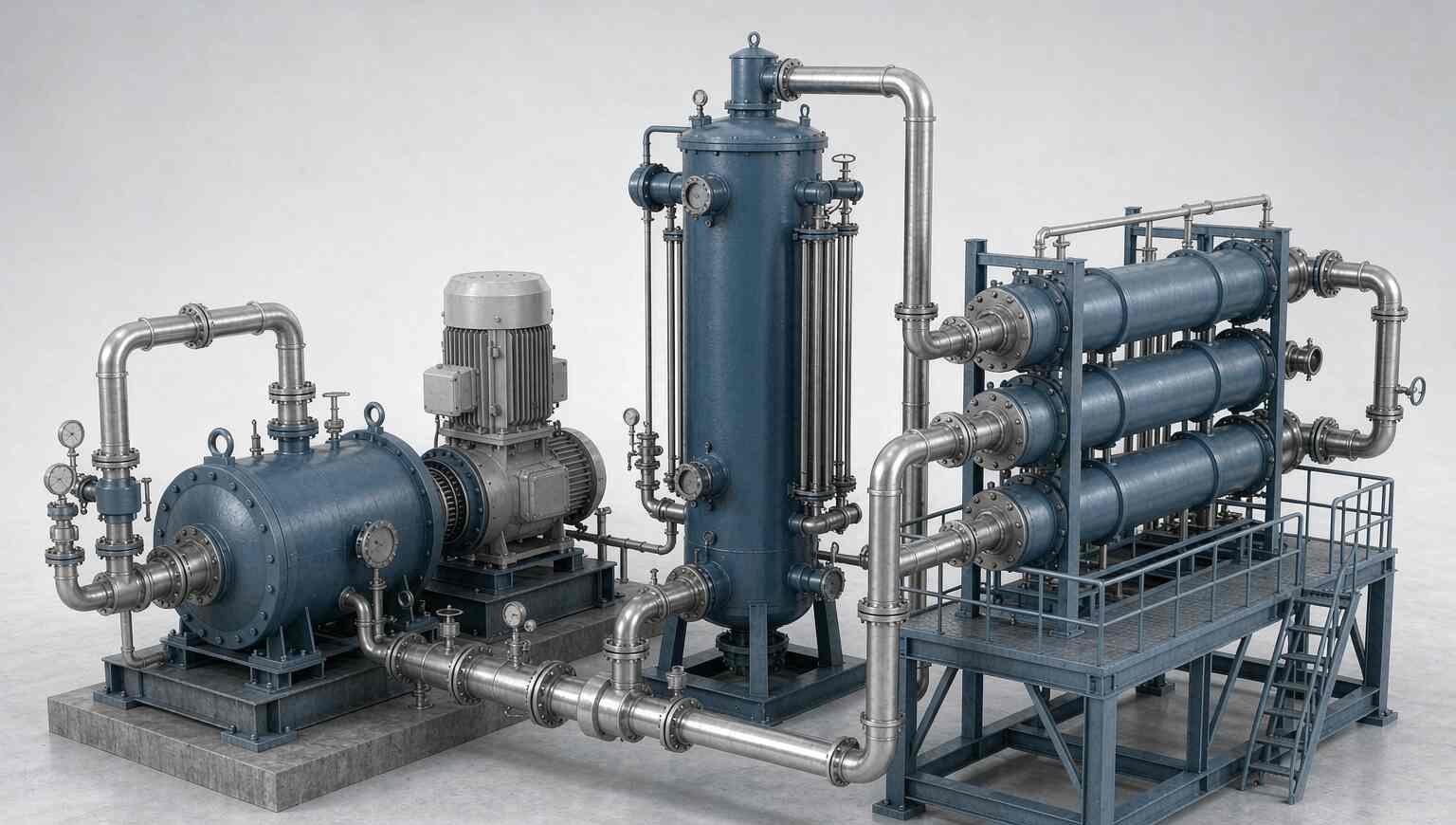
There are two ways in the project: one is liquid injection compression, and liquid compatible with the medium is injected synchronously into the compression chamber. The liquid vaporizes and absorbs heat to take away the heat of compression, with high isothermal efficiency. The price is that the latter section of the gas-liquid mixture needs to be separated, and the circulating liquid system has one more set of equipment. The other is shell-and-tube heat exchange. The compression cylinder body is equipped with a water-cooled jacket or an external intercooler to continuously guide to transfer, suitable for pressure ratio and load relatively stable conditions. The two paths can be combined: compression in sections with high pressure ratio, cooling between sections, and only a small section of temperature rise in each section. Which path to choose depends on the medium characteristics and load curve, the gas phase containing solvent priority injection liquid, inert gas and water-cooled jacket can meet.
Three reasons: first, the medium is safe, the solvent vapor will coke and polymerize at high temperature, the compressor efficiency will decrease after carbon deposition, the seal will fail, and the temperature will be held down by isothermal temperature, thus eliminating these hidden dangers from the source; The second is the energy consumption account. Both the condensation and membrane units in the rear section hope that the intake air temperature will be low. Isothermal compression saves the cost of secondary cooling, and the power consumption of the whole line is significantly lower than that of adiabatic plus cooling scheme; the third is the service life of the equipment. Heat is the accelerator for the wear of moving parts and the deterioration of lubricating oil. The compressor runs stably for a long period of time, and the maintenance interval of the whole line is lengthened. When the three are combined, the popularity rate of isothermal compression in solvent recovery conditions is naturally high. It is usually not wrong to evaluate it as the default route when selecting the type.
| Project | Normal compression | isothermal compression |
|---|---|---|
| Process characteristics | Large approximate adiabatic temperature rise | Small temperature rise of synchronous heat transfer |
| Outlet temperature | The pressure ratio can reach hundreds of degrees | Close to intake plus dozens of degrees |
| unit energy consumption | The rear section needs to be cooled twice. | Smooth connection of the rear section and power saving |
| Media adaptation | Afraid of thermal medium limited | Thermal solvent friendly |
| Device complexity | Simple structure | Liquid injection or water cooling system |
| Maintenance Focus | Regular maintenance | Cooling system and liquid circuit |
It is not the same thing: multi-stage compression is to divide the total pressure ratio into several sets or sections, and cooling between sections also exists; The key to isothermal compression is synchronous heat exchange in the compression chamber. Single stage can also be made isothermal, while multi-stage plus isothermal is a more thorough combination.
The liquid compatible with the process medium is commonly used in the same solvent or its condensate, and the injection volume is automatically adjusted according to the temperature rise control. The liquid is separated and recycled in the rear section, and the daily concern is the liquid level control and separation efficiency.
Some parts can be: if the load matches the structure, the temperature rise can be improved by installing an intercooler or a liquid injection pipeline; If the compressor type does not match the working condition, it is more economical to change the machine than to change the machine. Before the transformation, let the manufacturer evaluate the margin of the original machine.
This article by LuoyangWohong PetrochemicalEquipment Co., Ltd. arranges that the company provides design, manufacturing and operation and maintenance services for condensation recovery, membrane separation recovery and complete solvent recovery devices for chemical and pharmaceutical enterprises. If you need process evaluation or scheme configuration, please contact and exchange.
Mr. Li 13526990215

Hotline





