
How to recycle ethyl lactate waste gas? The main line consists of three steps: first, the discharge points of the ingredient, cleaning, and drying processes are sealed and collected, and then the solvent vapor is condensed and recovered according to the discharge temperature. The condensate is directly sent to the refining unit for dehydration and purification, and reused according to its quality, taking advantage of its good solubility with water. It has a boiling point of about 154 ℃, limited volatilization at room temperature, and emissions are concentrated in the drying and high-temperature processes. The collection and condensation configuration is arranged with a focus on high-temperature emission points, which is the main idea of this process line.
The first is high boiling point and limited volatilization at room temperature. The boiling point of about 154 ℃ results in significantly lower volatile emissions at room temperature compared to common ester solvents. The emission intensity during storage and transportation at room temperature is not high, and the condensation conditions are relatively mild. The energy consumption and frost risk of the refrigerant are lower than those of low boiling ester solvents.
The second is that emissions are concentrated in the thermal process. Electronic cleaning and drying operations, as well as concentration and drying processes in pharmaceutical and chemical industries, will bring a large amount of ethyl lactate vapor out with hot air. These points have high temperatures and concentrations, making them the main battlefield of the collection system; The normal temperature ingredients and storage and transportation process can be connected together as a low concentration continuous source.
The third is good compatibility. The compatibility between ethyl lactate and water is significantly better than that of conventional esters that are insoluble in water. If the condensate is not completely stratified or even not stratified after standing, the condensate treatment must be designed according to "refined dehydration", which requires cost calculation in the scheme stage.
The exhaust outlet of the drying and cleaning equipment is directly connected to the collection main pipe through a pipe, and the high-temperature section of the pipeline is insulated to prevent steam from condensing and accumulating liquid in the pipe in advance; The breathing port of the concentration and drying equipment is separately connected to a branch pipe, which is first buffered and stabilized before flowing into it; Local enclosures and ventilation should be used in the ingredient and storage process, and low concentration continuous source treatment should be applied. Verify the simultaneous use factor before merging multiple branches to avoid diluting concentration with high air volume and increasing backend load; Maintain the slope of the pipeline and set a low point for drainage.
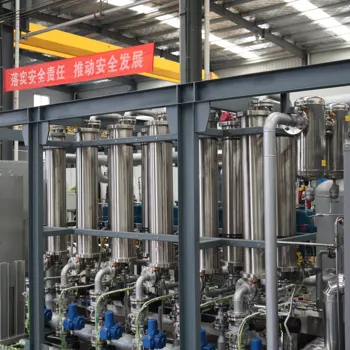
The high-temperature emission source is configured in two stages of condensation: the first stage pre cools and reduces the temperature of the high-temperature exhaust gas, and releases the carried water vapor, while the second stage condenses and recovers most of the ester vapor. Cooling capacity is recovered between the two stages to reduce energy consumption; Insulation and anti condensation measures should be taken for low-temperature pipelines and valves. Due to its high boiling point and tendency to condense, the condensation temperature required to achieve the same recovery rate is milder than that of low boiling point solvents; The low concentration branch at room temperature is merged into the main pipe and then into the condensation section, or an adsorption unit is equipped according to the concentration situation. The differences in recovery between it and other ester solvents are shown in the following table:
| comparison dimension | ethyl lactate | Conventional ester solvents |
|---|---|---|
| boiling point | About 154 ℃ | Mostly around 80 ℃ |
| Room temperature volatilization | Limited, emissions are concentrated in the hot process | Clearly, it continues to evaporate at room temperature |
| Condensation condition | Mild and low refrigerant energy consumption | Need for deeper cooling temperature |
| Stratification of condensate | Good compatibility, incomplete layering | Varieties that are insoluble in water can be left to stand and layered |
The condensate with good mutual solubility is directly sealed and sent to the refining unit without static stratification: the dehydration and purification conditions are determined according to the condensate components and moisture content, and the dehydration depth is determined according to the reuse quality requirements; Refined residual liquid is used or entrusted for disposal according to the components and quality, and the ledger is registered batch by batch. The recovered liquid is reused for batching or cleaning process after batch testing, and the water phase and refined residual liquid are merged into wastewater or disposal path for unified management, and the stock is controlled and first-in-first-out in occasions with long reuse cycle.
After the condensate is refined, dehydrated and tested in batches, those with quality meeting the batching requirements can be recycled for cleaning or batching. Batches with excessive moisture or impurities will continue to be refined or entrusted for disposal, subject to the measured data.
No. Ethyl lactate has good miscibility with water, and incomplete stratification is a medium characteristic. The scheme should have been designed according to the refined dehydration route. If the scheme is configured according to static stratification, it is not checked in the selection stage.
At the condensing end, high boiling point means easy condensation, mild cold depth temperature and low energy consumption. However, the mutual solubility characteristic transfers the cost to the condensate refining section, and the general ledger can only be clearly seen after the two sections are calculated together.
LuoyangWohong PetrochemicalEquipment Co., Ltd. provides design, manufacture, installation, commissioning and operation and maintenance services for medium recovery devices such as ethyl lactate for pharmaceutical, electronic cleaning and coating ink enterprises. Welcome to contact and exchange.
This article is organized by Luoyang wohong petrochemical equipment co., ltd. if you need ester solvent recovery scheme evaluation or on-site investigation, please contact and exchange.
Mr. Li 13526990215

Hotline





