
How to recycle dichloroethane waste gas? The main line is three steps: the chlorine-containing tail gas in the breathing, feeding and distillation links of the storage tank is first collected in a closed manner, and then the solvent vapor is condensed and recovered through two-stage condensation. The condensate is static and stratified by using its characteristics of being insoluble in water and heavier than water, and is reused or disposed of respectively. Its boiling point is about 83.5 ℃, and its volatilization is obvious at room temperature. The system tightness and corrosion resistance of equipment are the two key points of this process line.
The first is the boiling point is not high, volatile fast. The boiling point of about 83.5 ℃ means that there is perceptible volatility at normal temperature. Unorganized emission will be formed in the links of tank size breathing, loading and unloading trucks, feeding and vacuum pump discharge. The collection system shall check and approve the air volume according to the peak working condition.
The second is insoluble in water and heavier than water. The condensate can be stratified after standing still, and the recovered liquid is in the lower layer, the water phase is in the upper layer, and the drain of the stratification device is located in the upper part, which is contrary to common ester solvents. The design and operation procedures should be clearly written to avoid misarrangement.
The third is that it is not flammable, but it will produce irritating acid gas when it is decomposed by heat. The system does not need to do a full set of fire protection according to flammable media, but the corrosion resistance material selection, pump sealing and workshop ventilation of contact parts should be implemented to prevent leakage and accumulation.
The breathing port of the storage tank leads out the collection branch pipe to the main pipe; the vacuum pump and the top of the distillation tower are discharged into the separate lead pipe, which is stabilized by the buffer tank before entering the recovery system; the loading and unloading truck adopts the bottom loading and refueling gas recovery connector. The simultaneous use coefficient shall be approved before the multi-strand branch is merged to avoid large air volume to dilute the concentration and increase the condensation load at the rear end. The pipeline keeps the slope and sets a low point for drainage to prevent condensate from accumulating and blocking the road.
The mainstream configuration is two-stage condensation: pre-cooling and dehumidification at the front stage, which reduces the temperature of the exhaust gas and precipitates the carried water vapor, thus reducing frosting and water carrying on the heat exchange surface at the rear stage; The latter stage of cryogenic condensation recycles most chlorine-containing vapor. The heat exchanger is used for cold recovery between the two stages to reduce the operation energy consumption; The heat exchange surface, pipeline and valve in contact with the medium shall be checked for materials according to the corrosion resistance requirements, and the low temperature section shall be insulated to prevent condensation.
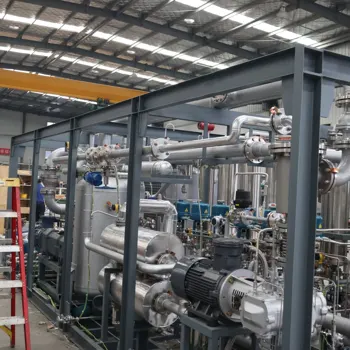
The setting of condensation temperature should be balanced between recovery rate and operating costs: the lower the temperature, the higher the recovery rate, but the energy consumption and frost risk increase synchronously. Generally, it is determined based on the characteristics of the medium and local emission limits, without making unfounded extreme low temperatures.
After the condensate is left standing and stratified, the lower recovered liquid is reused for production batching or sent to refining unit for treatment according to its quality; the upper aqueous phase is integrated into the wastewater system of the plant for unified treatment. The recovery difference between it and common ester ketone solvents is shown in the following table:
| comparison dimension | Dichloroethane | Common ester and ketone solvents |
|---|---|---|
| boiling point | About 83.5 ℃ | More than 56 ℃ |
| Flammability | Non-flammable, heated points to liberate acid gas | Most flammable, set up by flash point |
| Stratification of condensate | It is heavier than water, and the recovery liquid is in the lower layer | Insoluble in water varieties of recovered liquid in the upper layer |
| Key points of material selection | Resistance to chloride corrosion | Conventional material-based |
The condensate can be reused in the batching process after layered dehydration and quality verification. If the purity or moisture does not meet the requirements, it shall be sent to the refining unit for treatment and then reused, which shall be determined according to the measured quality.
Chlorinated hydrocarbons are corrosive to common materials under wet or heated conditions, and corrosion products will pollute the recovery liquid. The material of contact parts shall be checked according to the compatibility of media, which is the premise of long-term operation of the device.
No. The lower the temperature, the higher the recovery rate, but the energy consumption and the risk of frost blocking the road on the heat exchange surface rise simultaneously, and reasonable working conditions should be set according to the emission limit and medium characteristics, taking into account the operating cost.
LuoyangWohong PetrochemicalEquipment Co., Ltd. provides design, manufacture, installation, commissioning and operation and maintenance services for media recovery devices such as dichloroethane for chemical enterprises. Welcome to contact and exchange.
This article is organized by Luoyang wohong petrochemical equipment co., ltd. if you need chlorine-containing solvent recovery scheme evaluation or on-site investigation, please contact and exchange.
Mr. Li 13526990215

Hotline





