
The idea of recovering solvent by adsorption method is completely different from that of condensation: it does not rely on cooling and liquefaction, but allows exhaust gas to pass through porous adsorption materials, enriching the solvent vapor on the surface of the materials, and desorbing it with hot air flow or vacuum after the materials are adsorbed close to saturation, so as to obtain high-concentration solvent vapor and then condensing and recovering. This set of process is characterized by the low concentration of atmospheric waste gas "concentrated" into a small amount of high concentration of gas, suitable for those direct condensation is not economical occasions.
The internal surface area of the porous material is very large, and the solvent vapor molecules will be caught by the surface adsorption force when passing through. The lower the concentration in the gas phase, the more sufficient the adsorption driving force of the material, so the adsorption section can continue to work at a very low concentration. With the accumulation of adsorption capacity, the material gradually approaches saturation and the outlet concentration begins to rise. At this time, it is necessary to switch to desorption operation to drive out the adsorbed solvent and restore the adsorption capacity of the material. The alternation of adsorption and desorption forms the basis of continuous operation.
Desorption gas is the recovery link of the whole process: its solvent concentration is much higher than that of the original waste gas, the gas volume is much smaller, and the load and cost of condensation recovery are greatly reduced. The condensation temperature of the desorption gas is determined by the solvent component, and the condensate is reused after metering. Some processes will also use part of the desorption gas back to reduce the load of subsequent condensation. The specific arrangement depends on the gas volume and concentration conditions.
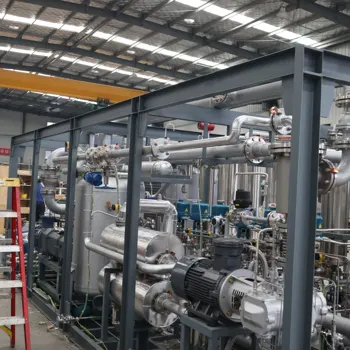
It cannot be generalized. The adsorption capacity of the adsorption material to different solvent components is quite different, and the high boiling point components are easy to remain and affect the regeneration, which is selected according to the characteristics of the components and materials.
The switching period depends on the gas concentration and bed loading, and is generally controlled according to the outlet concentration or running time; the multi-bed rotation design can achieve continuous processing without stopping.
Sure. The common combination method is adsorption before enrichment and concentration, condensation after liquefaction recovery, or condensation before recovery of the main body, adsorption after the tail gas, the order is determined according to the gas source conditions.
This article by LuoyangWohong PetrochemicalEquipment Co., Ltd. arranges that the company provides design, manufacturing and operation and maintenance services for condensation recovery, membrane separation recovery and complete solvent recovery devices for chemical and pharmaceutical enterprises. If you need process evaluation or scheme configuration, please contact and exchange.
Mr. Li 13526990215

Hotline





