
When it comes to solvent recovery units, one of the most frequently asked questions is what the recovery rate is. This question is not easy to answer directly, because the recovery rate is not an inherent parameter of the device, it also depends on the intake conditions, equipment configuration and operation mode. In order to obtain a meaningful value, it is necessary to measure the intake concentration, air volume and actual efficiency of the condensation section, and then calculate according to the material balance.
The most commonly used definition is the amount of solvent recovered per unit time as a percentage of the total amount of solvent entering the system at the same time. To calculate, you need to know the solvent mass flow at both ends of the inlet and outlet at the same time, both of which depend on actual measurement.
Another definition is the removal rate calculated according to the concentration drop. The two are close but not identical in value. When quoting, it is necessary to state which caliber is used.
In actual accounting, it is also necessary to distinguish between the recovery rate of the whole machine and the recovery rate of a single segment. The whole machine calculates the condensation, adsorption and other sections together, while the single section only looks at the contribution of a certain section. When doing optimization, you usually look at a single segment first, judge which segment the short board is in, and then go back to the whole machine accounting to see the overall effect.
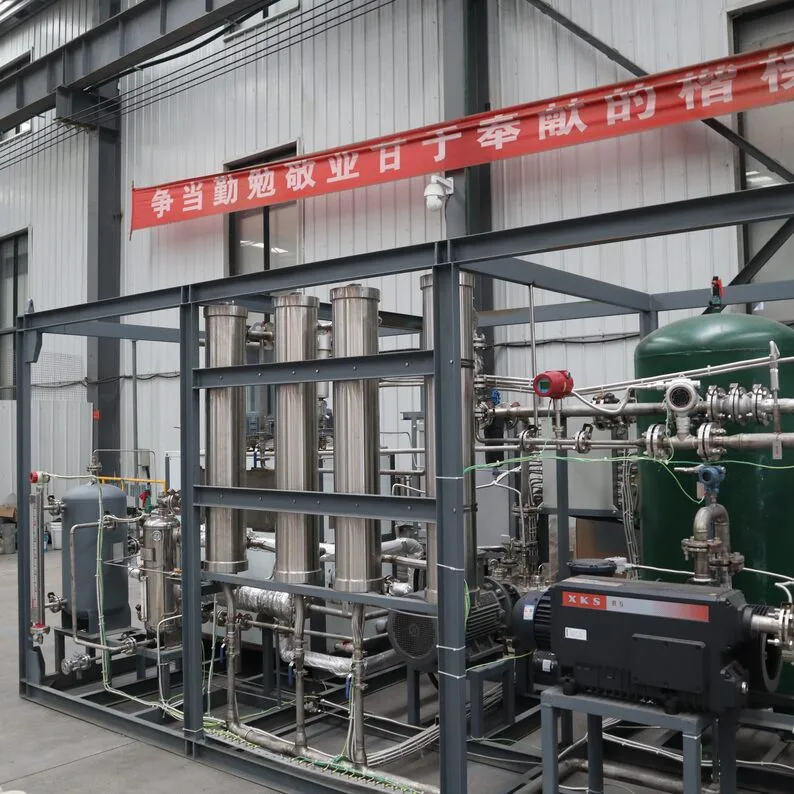
The intake air concentration is generally sampled on the branch pipe or main pipe with a portable detector, and the sampling point should be selected in the straight pipe section with stable airflow and uniform mixing. Intermittent operation of the process concentration fluctuations, need to be measured several times in time series, take a complete operation cycle of data, rather than just take an instantaneous value.
The detector should be calibrated according to the tested components before use. The response factors of different solvents are different. There will be deviation in directly measuring alcohols with the instrument calibrated with aromatic hydrocarbons. The test records should be recorded together with the production status and air volume at that time, otherwise the data cannot be explained later.
The mass flow rate of the solvent is equal to the air volume multiplied by the concentration multiplied by the time. The measurement error of the air volume will be directly amplified into the result, so the air volume should be averaged according to the multi-point measurement of the cross-sectional wind speed of the straight pipe section, instead of being estimated according to the nameplate value of the fan.
| Accounting Item | Measurement method | Attention point |
|---|---|---|
| Intake air concentration | Portable instrument for sampling in straight pipe section | Intermittent process is measured many times according to the complete cycle. |
| Airflow | Cross-section wind speed multi-point average | According to the measured value, not according to the nameplate value |
| Solvent mass flow | Air volume multiplied by concentration multiplied by time | The two items should be at the same time and at the same measuring point. |
| condensation efficiency | Concentration difference between inlet and outlet with differential pressure | Record the cleaning cycle of the heat exchange surface for comparison. |
| Amount of recovered liquid | Metering tank or flow meter | Comparison with process solvent input |
| Running hours | Record the actual boot time | Used for commutation cycle average recovery |
The efficiency of the condensation section can be seen from two aspects: one is the difference in import and export concentration, which reflects how much this section actually receives; The second is the state of the heat exchange surface. When the state deteriorates, the efficiency at the same temperature level will decrease. If the outlet concentration is recorded together with the pressure difference during operation, it can be seen whether the efficiency is declining.
Segmented evaluation is more instructive than whole machine evaluation. If the efficiency of the first stage is normal and the second stage is obviously low, the problem may be frost on the heat exchange surface of the low temperature section or the cooling capacity is insufficient, and the inspection direction is relatively clear.
The design value gives the expected results under specific working conditions. In actual operation, the intake air conditions are often different from the design, and there will be deviations when directly applied. To obtain a value that can be used for judgment, it is more reliable to measure it under actual operating conditions.
Not enough. After the device runs for a period of time, the state of the heat transfer surface will change, and the recovery rate will also change. It is recommended to establish a benchmark at the initial stage of commissioning, and then retest according to the clean-up cycle or quarterly to form a comparable data series.
The flow velocity distribution on the pipe section is not uniform, and it is obviously low near the pipe wall. Single-point measurement is easy to deviate from the cross-sectional average, and the average is measured at multiple points in the straight pipe section according to the grid, and the result is closer to the real air volume.
This article by LuoyangWohong PetrochemicalEquipment Co., Ltd. arranges that the company provides design, manufacturing and operation and maintenance services for condensation recovery, membrane separation recovery and complete solvent recovery devices for chemical and pharmaceutical enterprises. If you need process evaluation or scheme configuration, please contact and exchange.
Mr. Li 13526990215

Hotline





