
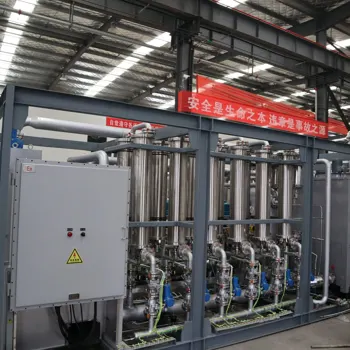
The solvent recovery unit is prone to several types of concentration problems in winter: condensate freezing and blocking in pipelines and low points, drift of control instrument readings, and different load of condensation section from summer, resulting in parameters no longer adapting. These conditions are generally exposed after cooling down, and they are often temporarily shut down when the device alarms or the condensate cannot be discharged. LuoyangWohong PetrochemicalThe equipment provides winter operation adjustment and anti-freezing supporting services for the recovery device. The core work is to sort out the easily frozen parts before cooling down and check the parameters again according to the low temperature working conditions.
The first category is frozen. The low point of the pipeline, the drain valve and the interface of the condensate tank level gauge are easy to freeze first as long as there is liquid accumulation and the heat preservation is not in place. The second category is the instrument drift, part of the transmitter in the low temperature environment reading deviation becomes larger, resulting in the control loop in the wrong value adjustment. The third category is that the parameters are no longer adapted: after the ambient temperature drops, the actual load of the condensation section becomes smaller. If the temperature level and cooling capacity distribution are still set according to summer, the system will operate in the low-efficiency area. The fourth category is the efficiency change of air-cooled equipment, and the relationship between fan speed and ambient temperature needs to be reconfirmed.
Comparison of winter and summer operation
| Comparison item | Summer operation | Winter operation concerns |
|---|---|---|
| Condensation load | High ambient temperature and heavy load | The load drops and the cold quantity needs to be redistributed. |
| Freezing risk | Basically None | Low point effusion and instrument interface are easy to freeze |
| Air-cooled equipment | Focus on heat dissipation capacity | Focus on rotational speed and antifreeze protection |
| Key Inspection Points | Temperature and pressure trends | Added drain and heat preservation inspection |
In the implementation, the operation records and pipeline drawings of the device shall be retrieved first, and the frozen parts and heat preservation status shall be checked on site, and then the list of anti-freezing measures and parameter adjustment suggestions shall be determined in combination with the local climate conditions. It can be completed centrally before cooling, or it can be implemented in batches according to the workshop maintenance window. Written records shall be provided after the adjustment is completed for the convenience of post personnel in subsequent operation.
Most of the winter problems are not equipment failures, but preparations are not completed before the temperature drops. Sorting out the easy freezing points and checking the parameters according to the low temperature working conditions, the device can usually survive the winter smoothly without waiting for shutdown.
Mr. Li 13526990215

Hotline





