
N-methylpyrrolidone (NMP) has a boiling point of about 802 degrees Celsius and is completely miscible with water. These two characteristics directly determine its recovery route: it cannot be taken down only by low-temperature condensation like low-boiling solvents. Usually, most NMP needs to be converted from gas phase to liquid phase through condensation, and then dehydrated or distilled and purified according to the water content; the design of the condensing section should also consider the characteristics of low vapor pressure and easy residue in the pipeline at room temperature of NMP. Lithium battery electrode coating, fine chemical synthesis and electronic cleaning are the main use scenarios of NMP, in which the exhaust air volume of the coating workshop is large and the concentration of NMP is medium, so the recycling configuration needs the most effort.
The main sources include oven exhaust (large air volume and high temperature) for coating and drying processes, reactor exhaust and vacuum system outlets for synthesis reactions, short-term exhaust for equipment cleaning and pipe replacement, and breathing exhaust from batching tanks and storage tanks.
It is characterized by high boiling point, low vapor pressure, and low gas phase concentration; it is miscible with water, and the recovered liquid is mostly water; it is sensitive to temperature and will decompose when heated at high temperature for a long time. The superposition of these articles determines that the recovery of NMP is neither a simple condensation problem nor a simple separation problem.
The exhaust temperature of the oven is usually above one hundred degrees Celsius, and directly entering the condensation section will bring a large sensible heat load, and advanced heat exchange precooling is more economical. Exhaust containing dust or oil mist should be filtered first to avoid polluting the heat exchange surface.
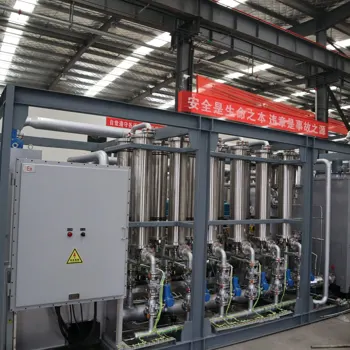
Because the NMP vapor pressure is low, the pressure drop of the collection pipe network should be controlled. Too long pipelines and too many elbows will cause solvent to condense in the pipeline, which will not only lose materials, but also block the pipeline. The two items of pipeline insulation and low-point drainage should be in place.
The configuration shall be determined item by item according to the exhaust concentration, water content and reuse requirements, and the equipment shall not be selected only according to the treatment air volume.
| Segment | Configuration considerations | Description |
|---|---|---|
| Pre-cooling | Heat exchange with recovered cold air to recover sensible heat | Reduce the cooling load, while reducing the pipeline liquid |
| Condensation | According to the exhaust gas concentration and water content, set the temperature level | Exhaust with very low concentration is limited by condensation recovery alone |
| Follow-up check | Condensation followed by adsorption or other check section | Configuration when the export concentration requirements are strict |
| Dehydration | The recovered liquid needs to be treated when it contains water. | Select distillation or dedicated dehydration unit depending on reuse purity |
| Purification | Determine the purity target according to the process requirements | When there are requirements for metal ions and other indicators, separate purification section shall be prepared. |
| Material | Compatible with NMP and aqueous systems | Avoid dissolution and corrosion caused by long-term contact |
The recovered NMP should be returned to the process, and the moisture content, color, purity and metal ion content should be generally concerned. The coating process usually has a clear upper limit on the water content of NMP, which will affect the stability of the slurry, so the dehydration link is often the focus of the whole configuration. If the reuse requirements are higher, further processing is needed in the purification section.
High boiling point means that the vapor pressure is low at room temperature, and most of the NMP can be converted into liquid phase by condensation to an appropriate temperature level, which is quite effective for exhaust gas with higher concentration. However, the concentration is very low, the amount of gas is very large, the condensation recovery rate is limited, need to cooperate with other means of control.
Depending on the process requirements for moisture content selection. If the requirement is not strict, it can be simply dehydrated and used in low-requirement occasions; if the requirement is strict, it needs to be treated to the specified index by distillation or special dehydration unit before reuse.
Under the conventional process, the purity of recovered NMP can be achieved at a higher level by condensation and purification treatment. Where there are special requirements for metal ions, chromaticity and other indicators, it shall be proposed at the scheme stage, and the purification section and contact material shall be configured accordingly.
This article by LuoyangWohong PetrochemicalEquipment Co., Ltd. arranges that the company provides design, manufacturing and operation and maintenance services for condensation recovery, membrane separation recovery and complete solvent recovery devices for chemical and pharmaceutical enterprises. If you need process evaluation or scheme configuration, please contact and exchange.
Mr. Li 13526990215

Hotline





