
Methyl tert butyl ether (MTBE) is a commonly used oxygen-containing compound in gasoline blending, with a boiling point of about 55 ℃. It evaporates significantly at room temperature and produces ether containing exhaust gases during tank respiration, loading and unloading, blending operations, and other processes. Its recycling mainline can be summarized as follows: closed collection at the discharge point, two-stage condensation collection, and the main volume. The condensate is not as clear as hydrocarbons due to its partial solubility and stratification with water, so separation and wastewater treatment should be arranged in advance.
The first is low boiling point and fast volatilization. The boiling point of about 55 ℃ is much lower than that of common benzene derivatives, and there is significant volatilization when stored at room temperature in an open environment. During the high temperature period in summer, the emissions from tank respiration and unloading operations further increase, and the collection system should be determined according to the peak working conditions of tank respiration and loading and unloading operations.
The second is partially miscible with water. Its solubility in water is significantly higher than that of general hydrocarbons, and the static stratification of the condensed recovery liquid is not as crisp as that of gasoline, oil, and gas. The synergistic treatment of recovery liquid dehydration and ether containing wastewater is the focus of this process line, and pure hydrocarbon solutions cannot be blindly applied when selecting.
The third is flammable. As a component of gasoline, the fan, electrical and anti-static grounding of the exhaust system are treated as flammable media, and the collection pipeline is kept conductive and grounded. The quick connectors and recovery valves at the loading and unloading ports should be regularly checked for sealing.
Install a breathing valve on the breathing port of the storage tank and seal it with nitrogen in the tank area, and introduce the breathing exhaust gas into the collection branch pipe; The loading and unloading operation adopts a bottom loading refueling gas recovery joint, and the sealing rings between the crane pipe and the pipe mouth are regularly replaced; Partial fencing and directional ventilation should be added to open operation points such as blending tanks and cleaning. Verify the simultaneous use factor before multiple branches converge into the main pipeline to avoid dilution of concentration by high air volume and increase of condensation load at the rear end; Maintain the slope of the pipeline and set a low point for drainage to prevent condensation from accumulating and blocking the path.
The mainstream configuration is two-stage condensation: the front stage pre cooling dehumidification reduces the exhaust gas temperature and releases the carried water vapor, reducing frosting and water carryover on the rear stage heat exchange surface; The secondary cryogenic system condenses and recovers most of the ether vapors. Use heat exchangers between two stages to recover cooling capacity and reduce operating energy consumption; The selection of materials for pipelines and valves should be checked for compatibility with ether containing media, and insulation and anti condensation measures should be taken in the low-temperature section.
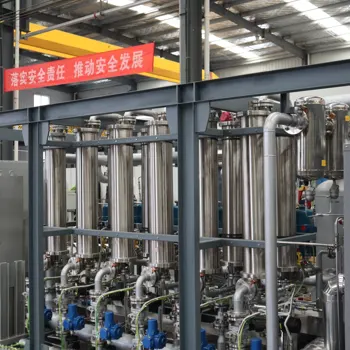
The setting of condensation temperature should be balanced with emission requirements and operating costs: the lower the temperature, the higher the recovery rate, but the energy consumption and the risk of frosting on the heat exchange surface increase synchronously. Generally, it is determined based on the characteristics of the secondary medium and local emission limits, without making unfounded extreme low temperatures.
The condensate is first subjected to static settling or coalescence separation for preliminary dehydration. The aqueous phase cannot be directly discharged due to the presence of some ether compounds, and is merged into the factory's alcohol ether wastewater system for unified treatment or reflux compounding; The recycled liquid shall be reused for blending or sent to qualified units for disposal according to its quality. The processing differences between it and other common varieties are shown in the following table:
| comparison dimension | Methyl tert butyl ether | Hydrocarbon gasoline, oil and gas |
|---|---|---|
| volatility | Boiling point is about 55 ℃, with significant volatilization at room temperature | Multi component mixture, light components evaporate first |
| Stratification of condensate | Partially miscible with water, incomplete layering | Poor solubility with water, prone to delamination when left to stand |
| Water phase disposal | Integrate into the ether containing wastewater system for collaborative treatment | Standard treatment after simple separation |
| Recycling destination | Reuse, reconcile or entrust disposal | Return spray tank or reuse |
After dehydration and quality verification, the condensate can be returned to the reconciliation process; if the water content or purity does not meet the requirements, it shall be sent to the refining unit for treatment or entrusted to a qualified unit for disposal, which shall be determined according to the measured quality.
Because it is partially miscible with water, the water produced in the condensation and separation links is miscible with ethers and cannot be simply treated as ordinary oily wastewater. Only by designing the direction of the water phase in advance can make up lessons after operation be avoided.
No. The lower the temperature, the higher the recovery rate, but the energy consumption and frost blocking risk rise simultaneously, should be set according to the emission limit and medium characteristics of reasonable conditions, taking into account the operating cost.
LuoyangWohong PetrochemicalEquipment Co., Ltd. provides design, manufacture, installation, commissioning and operation and maintenance services for oil and gas recovery and solvent recovery devices for oil depots, gas stations and chemical enterprises, and customization of recovery schemes for special media such as ethers. Please contact and exchange.
This article is organized by Luoyang wohong petrochemical equipment co., ltd. if you need to evaluate the recovery scheme of methyl tert-butyl ether and other media or conduct on-site investigation, please contact and exchange.
Mr. Li 13526990215

Hotline





