
Chlorobenzene is a common high boiling point chlorobenzene solvent in dyes, pesticides, pharmaceutical intermediates and organic synthesis industries. Its boiling point is about 132 ℃, and its volatilization speed is medium at normal temperature. However, it will enter the gas phase in a large amount in high temperature processes such as distillation, vacuum desolvation and reaction kettle heating. Its recovery idea can be summarized in two sentences: closed collection of tail gas, main collection of condensation in the front section, residual collection of adsorption at the end-high boiling point varieties cannot be collected to the end by condensation at normal temperature alone, and the combined process can take into account both recovery rate and emission requirements.
The first is high boiling point, low vapor pressure. The boiling point of about 132 ℃ means that the volatile amount stored at normal temperature is limited. The focus of unorganized emission is not on storage but on high temperature processes: non-condensable gas at the top of distillation tower, exhaust of vacuum pump and pressure relief of reactor. Chlorobenzene enters the gas phase greatly with the process temperature. The concentration of tail gas fluctuates obviously with the working conditions. The collection system should be designed according to the most unfavorable working conditions.
Secondly, it is slightly soluble in water and chemically stable. Chlorobenzene has poor miscibility with water, which is beneficial to recovery-condensed recovered liquid is easy to layer with water and has a light dehydration burden; However, good chemical stability also means that it is difficult to biodegrade. Once it enters wastewater with direct discharge or dissolution loss of tail gas, subsequent treatment is difficult, and the recovery process should try to keep the amount as much as possible.
The third is flammable liquid. Fan selection, electrical explosion-proof and anti-static grounding of exhaust gas system are treated as flammable medium, and cannot be relaxed because of slow volatilization at normal temperature.
The high-temperature process is the main channel for chlorobenzene to enter the tail gas, and each branch is led out separately and cooled before being introduced into the main pipe. The concentration of chlorobenzene vapor entrained by the exhaust of the vacuum pump is high, so it is appropriate to connect to the condensation recovery unit nearby to avoid the accumulation pipe of condensate during long-distance transportation. At normal temperature open operation points (blending, filling and cleaning), local enclosure and directional exhaust shall be added to restrict the airflow in the hood and then introduce the main pipe.
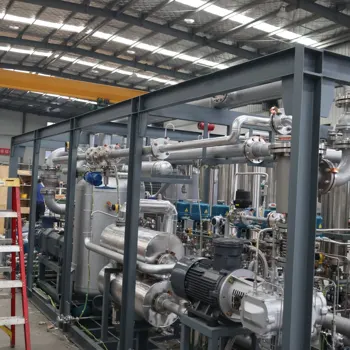
The pipeline shall maintain the slope and set a low point for liquid discharge. When multiple branches are merged, the air volume shall be approved according to the simultaneous use coefficient to avoid dilution of concentration by large air volume and increase the load of condensation and adsorption at the back end. Before the tail gas enters the condensation section, filter and remove foam to protect the heat exchange surface.
The boiling point of chlorobenzene is about 132 ℃, and a considerable part can be condensed out by water cooling at normal temperature. The high-temperature tail gas will cool down first and then enter the condensation section, and the load will be much smaller. In the two-stage arrangement, the front stage is mainly cooled with normal temperature water or chilled water, and the rear stage is finished with lower refrigerant temperature. How cold is it and how much the recovery rate can reach are determined by the measured concentration and recovery rate targets, and are not based on estimation. In applications with stringent emission requirements, a second-stage adsorption unit is installed downstream of the condenser to capture any residual vapors. The adsorbent is periodically desorbed and regenerated, and the desorbed gas is returned to the condenser for closed-loop recovery.
| Recycling route | Applicable scenarios | Configuration considerations |
|---|---|---|
| Single-stage or two-stage condensation | High concentration, single component tail gas | Reduce the temperature and load first, and the temperature level shall be approved according to the actual measurement. |
| Condensation adsorption finishing | Occasions with strict emission requirements | Condensation to collect the main amount, end adsorption pocket residue, regular regeneration |
| adsorption concentration desorption condensation | Low concentration tail gas with large air volume and low concentration | Concentrate and reduce the air volume first, and the condensing unit is configured according to the small air volume and high concentration |
Chlorobenzene recovery liquid has poor miscibility with water, and most of the water can be separated by static stratification, and then filtered to remove impurities. According to the purpose of classification and reuse-cleaning, dilution and use can be reused after passing the test, and the synthesis and ingredient use sensitive to purity are further refined according to the water content and distillation range test data. The recovered liquid shall be temporarily stored and kept airtight, and the container shall be marked with the variety and testing status.
The input volume and recovery volume are recorded on a daily basis in the ledger. When the recovery volume drops abnormally, priority is given to checking the sealing of the collection point, the drift of condensation temperature and the scaling of the heat exchange surface, and then checking the regeneration status of the adsorption unit.
Classify by use. Cleaning and dilution purposes can be reused after layering and impurity removal; For purposes sensitive to purity, refine them according to moisture and distillation range test data, and reuse them after passing the retest.
The amount received is OK, but the bottom is not enough. The condensation ratio of normal temperature water cooling to high boiling point varieties is indeed higher than that of low boiling point varieties, but high temperature exhaust gas should be cooled and then condensed. For occasions with strict emission requirements, the latter stage still needs to arrange low-temperature finishing or adsorption bottoming.
The main difference lies in the boiling point. Dichloromethane has a boiling point of about 40 ℃, volatilizes quickly at normal temperature and is difficult to condense, requiring a lower refrigerant temperature. Chlorobenzene has a boiling point of about 132 ℃ and is easy to condense. The focus is on sealing the collection system and cooling the high-temperature tail gas. Both are chlorinated hydrocarbons, and the system material and seal selection must be compatible.
According to the simultaneous use coefficient, the total air volume shall be approved and buffer shall be set. For the branch with low concentration and large air volume, adsorption and concentration shall be carried out first, followed by desorption and condensation, so that the condensation unit can operate stably under small air volume and high concentration.
This article by LuoyangWohong PetrochemicalEquipment Co., Ltd. arranges that the company provides design, manufacturing and operation and maintenance services for condensation recovery, adsorption recovery and complete solvent recovery devices for the chemical, dye and pharmaceutical intermediate industries. If you need process evaluation or scheme configuration, please contact and exchange.
Mr. Li 13526990215

Hotline





