
Methyl acetate is a low boiling point ester solvent commonly used in coatings, inks, adhesives and fine chemical industries, with a boiling point of about 58 ℃, fast volatilization and low flash point at room temperature. Its recovery idea can be summarized in two sentences: tail gas is collected in a closed manner first, and then the solvent is recovered by more than two stages of deep condensation-normal temperature water cooling has limited recovery rate for this low boiling point variety, and a lower refrigerant temperature must be arranged for finishing; For spray drying tail gas with large air volume and low concentration, it is advisable to adsorb and concentrate before desorption and condensation, and the recovered liquid is separated and reused according to the reuse purity requirements.
First, it has a low boiling point and evaporates quickly. The boiling point of about 58 degrees C means that the saturated vapor pressure at room temperature is obviously higher, open storage, pump leakage, spray atomization and other links will quickly form exhaust gas, the collection system is slightly open, unorganized emissions are considerable. The second is flammable and volatile. Esters are flammable liquids with low flash point. Fan selection, anti-static grounding and electrical explosion-proof cannot be saved. Pipeline transportation is treated as flammable medium.
The third is that it has a certain solubility in water, which is significantly higher than that of commonly used esters such as ethyl acetate. The dissolution loss in the process of contact with water (water washing and wet defoaming) cannot be ignored. The design of the recovery system should minimize the direct contact between tail gas and water to prevent the solvent from becoming the burden of wastewater treatment when dissolved in water.
The normal temperature open operation point (blending, filling and manual cleaning) is the continuous volatilization source. Local enclosure and directional exhaust are added to restrict the air flow in the cover and then introduce into the main pipe. The spraying room organizes the air flow according to the cross-sectional wind speed, and the air temperature at the end of the drying section is high. A separate branch circuit is set up to lead out, and the cooling section is cooled before entering the condensation section. When multiple branch ducts converge, the airflow shall be determined based on the simultaneous-use factor; the ductwork shall maintain a proper slope and be equipped with low-point drains for liquid discharge.
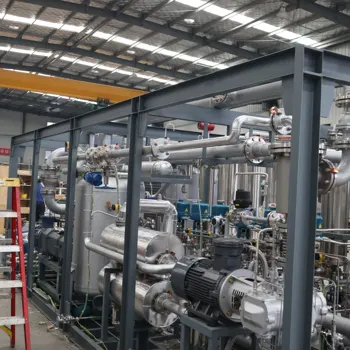
Before the tail gas enters the condensation section, filter and defoam to protect the heat exchange surface. Low boiling point varieties will continue to volatilize in the normal temperature pipeline, the collection pipeline will be as short as possible, with fewer turns, and the negative pressure section will be kept closed to avoid secondary leakage.
The boiling point of methyl acetate is about 58 ℃, which is much more difficult to condense than high boiling point varieties such as xylene and propylene glycol methyl ether. Only a small part can be condense out by water cooling at room temperature. Generally, the recovery rate should be improved by more than two stages: the front stage is water-cooled at room temperature or pre-cooled with frozen water, the load is pressed down, the rear stage is closed at a lower refrigerant temperature, and the residual steam is condensed as much as possible. How cold is low and how much the recovery rate can be determined by the measured concentration and recovery rate target, not by estimation. The lower the temperature level, the higher the energy consumption. Blind deep cooling is not cost-effective.
In the case of strict emission requirements, a first-stage adsorption end can be added after condensation to trap the residual low-concentration vapor; the adsorbent is periodically regenerated or replaced, and the desorbed gas is returned to the condensation unit for closed-circuit recovery.
| Recycling route | Applicable scenarios | Configuration considerations |
|---|---|---|
| More than two-stage deep condensation | Single variety, high concentration of tail gas | Pre-cooling of the front stage reduces the load, and the rear stage ends at low temperature, and the temperature level is approved according to the actual measurement. |
| adsorption concentration desorption condensation | Spraying and drying tail gas with large air volume and low concentration | Concentrate first to reduce the air volume, and the condensing unit is configured according to the small air volume and high concentration. |
| Condensation adsorption finishing | Occasions with strict emission requirements | Condensation to collect the main amount, end adsorption pocket residue, adsorbent regular regeneration |
The recovered liquid is filtered to remove impurities first, and then reused according to different uses: cleaning and dilution uses have loose requirements on moisture and chroma, and can be reused after passing the test. For applications sensitive to purity such as paint preparation and adhesive production, the separation and drying depth shall be arranged according to the moisture and distillation range detection data. The recovered liquid is temporarily stored and kept airtight and a breathing valve is left. Low boiling point varieties volatilize quickly at normal temperature. The storage tank is in good condition for sun protection and cooling and anti-static grounding. The container shall indicate the varieties and testing status.
The input volume and recovery volume are recorded on a daily basis in the ledger. When the recovery volume drops abnormally, first check the sealing of the collection point, the drift of condensation temperature and the scaling of the heat exchange surface, and then check the regeneration status of the adsorption unit.
Classify by use. Cleaning and dilution applications can be reused after filtering and removing impurities; For moisture-sensitive applications, separation and drying shall be arranged according to the detection data, and reuse shall be carried out after the distillation range is qualified.
No. The lower the temperature level, the higher the refrigeration energy consumption. Generally, more than two stages of cascade condensation are used, and the lower temperature of the latter stage is only responsible for finishing. The specific amount of cold is determined by the measured concentration and recovery rate to avoid blind deep cooling.
It's not suitable. Direct condensation requires processing the entire air flow, resulting in large equipment size and high energy consumption. This kind of tail gas should be adsorbed and concentrated first, then desorbed and condensed, so that the condensing unit can operate under low air volume and high concentration.
The recovery route is similar, all are closed collection and deep condensation. Methyl acetate has lower boiling point, faster volatilization, lower required condensation temperature, and more sensitive to system tightness; both are flammable esters, and the explosion-proof and anti-static requirements are consistent.
This article by LuoyangWohong PetrochemicalEquipment Co., Ltd. arranges that the company provides design, manufacturing and operation and maintenance services for condensation recovery, membrane separation recovery and complete solvent recovery devices for chemical, coating and adhesive industries. If you need process evaluation or scheme configuration, please contact and exchange.
Mr. Li 13526990215

Hotline





