
How to recover isopropyl acetate waste gas? The main line consists of three steps: the ester containing tail gas from the spraying, cleaning, and storage and transportation processes is first collected in a sealed manner, and then most of the steam is condensed and recovered through two-stage condensation. The condensate is then dehydrated in layers and reused according to its quality. It has a boiling point of about 89 ℃ and is highly flammable. The sealing of the collection system, anti-static measures, and condensate dehydration are the three key points of this process line.
The first is low boiling point and fast volatilization. The boiling point of about 89 ℃ belongs to the relatively volatile range in ester solvents, and it evaporates significantly when exposed at room temperature. Continuous emissions are formed in spraying and cleaning sites, as well as in tank size breathing.
The second is extremely flammable. The fans, electrical components, and anti-static grounding of the exhaust system are treated as flammable media, and the collection pipelines are kept conductive and grounded. Ventilation and concentration control at the work site are carried out in accordance with regulations.
The third is slightly soluble in water. The condensate can be stratified by standing still, but there are slightly more varieties that are dissolved in water than insoluble in water. Before reuse, a layer of dehydration is usually added. The combination of stratification and dehydration is described in the condensate management section below.
Partial enclosure and directional ventilation should be installed around the spraying line and cleaning tank; The collection branch pipe is led out from the breathing port of the storage tank and flows into the main pipe; The loading and unloading vehicle adopts a bottom loading refueling gas recovery joint. Verify the simultaneous use factor before merging multiple branches to avoid diluting concentration with high air volume and increasing the condensation load at the rear end; Maintain the slope of the pipeline and set a low point for drainage.
The mainstream configuration is two-stage condensation: the front stage pre cooling dehumidification reduces the exhaust gas temperature and releases the carried water vapor; The secondary cryogenic system condenses and recovers most of the ester vapors. Use heat exchangers between two stages to recover cooling capacity and reduce operating energy consumption; Insulation and anti condensation measures should be taken for low-temperature pipelines and valves, and anti-static and fire-resistant facilities should be implemented according to the requirements of flammable media in the system.
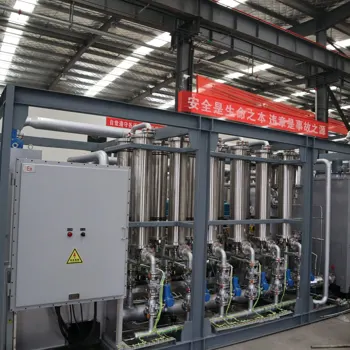
The setting of condensation temperature should be balanced between recovery rate and operating costs: the lower the temperature, the higher the recovery rate, but the energy consumption and frost risk increase synchronously. Generally, it is determined based on the characteristics of the medium and local emission limits, without making unfounded extreme low temperatures.
After the initial dehydration of the condensate through static layering, it is reused for paint mixing or cleaning processes according to its quality. For batches with high moisture content, a drying treatment is added; The water phase is merged into the factory wastewater system for unified treatment. The comparison of its recovery with other ester solvents is shown in the following table:
| comparison dimension | Isopropyl acetate | Common ester solvents |
|---|---|---|
| boiling point | About 89 ℃, significant volatilization at room temperature | By variety, the span is relatively large |
| water-soluble | Slightly soluble, with slightly more residual water after stratification | Most of them are insoluble in water |
| Condensate treatment | Layered and supplementary dehydration | Layered static placement is the main approach |
| Security Defense | Extremely flammable, the entire system is designed to withstand flammable media | Fortify according to flash point classification |
The condensate can be reused for paint mixing or cleaning after being subjected to layer wise dehydration and quality verification; If the purity or moisture content does not meet the requirements, it shall be dried or sent to the refining unit for processing, depending on the actual measured quality.
Directly condensing the entire room with high air volume is not cost-effective, as diluting the air volume will increase the condensation load. Local enclosure collection should be implemented at the spraying point to control the air flow within the necessary range, which is the most economical condensation solution.
The collection pipeline shall be conducted and grounded throughout the whole process, the flange bridge shall be intact, the fan and electrical equipment shall be selected according to flammable medium, and the bottom loading method with recovery joint shall be used for loading and unloading. The inspection shall be carried out periodically and records shall be kept.
LuoyangWohong PetrochemicalEquipment Co., Ltd. provides design, manufacture, installation, commissioning and operation and maintenance services for medium recovery devices such as isopropyl acetate for paint, ink and electronic cleaning enterprises. Please contact and exchange.
This article is organized by Luoyang wohong petrochemical equipment co., ltd. if you need to evaluate the recovery scheme of isopropyl acetate and other media or conduct on-site investigation, please contact and exchange.
Mr. Li 13526990215

Hotline





