
Isopropanol is used in electronics, medicine, coatings and cleaning industries. It is characterized by a boiling point of about 82 ° C and is completely miscible with water. These two characteristics determine that its recovery cannot copy the practice of aromatic hydrocarbons such as toluene and xylene: low boiling point means that the condensation temperature is lower, and mutual solubility with water means that the recovered liquid often brings water and is usually dehydrated before reuse. The common practice is to condense and recover first, and then decide whether to purify according to the purpose.
The first is easily soluble in water. If there is water in the collection line and condensation section, the recovered liquid will become an alcohol-water mixture and the concentration will be pulled down. The second is that the boiling point is low, and the condensation ratio of isopropanol at the same temperature is lower than that of xylene, requiring a lower temperature or a larger heat exchange area. The third is often shared with ethyl acetate, ethanol, etc., the tail gas is a mixed component, and the recovery liquid is also mixed.
In addition, the volatilization rate of isopropyl alcohol is faster than that of water, and the concentration near the liquid surface rises faster during open operation, but it will soon be diluted due to air flow. This is also the reason why the collection hood should be as close to the liquid surface as possible and not far from the operating point.
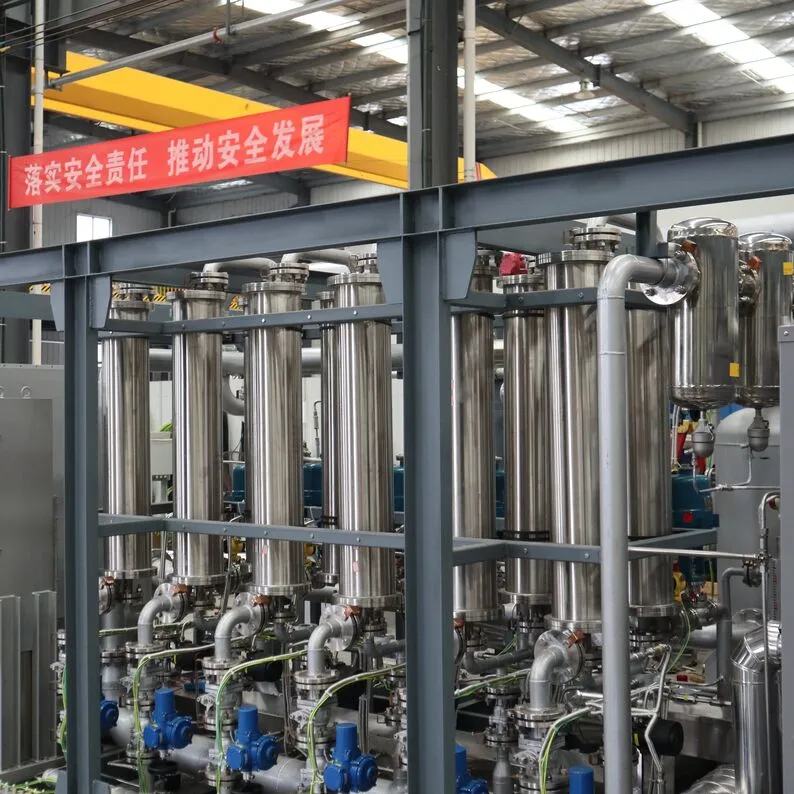
The use of isopropyl alcohol occasions for cleaning, wiping and liquid, the point is more dispersed. The method is to group by post, and make the top of the wiping table and cleaning tank into local enclosure and negative pressure to prevent the concentration from being lowered by the overall exhaust of large air volume.
If there is a water-containing process in the workshop at the same time, the collection pipeline should be careful to avoid being combined with high-humidity gas, otherwise the load of the condensation section will increase significantly.
The wiping operation of the electronic industry is often carried out in the clean area. The selection and arrangement of the collection system should take care of the airflow organization in the clean area. The hood should not be located in a position that will destroy the laminar flow. Such occasions are generally considered together with the design of the clean area.
According to the boiling point of isopropyl alcohol, the condensation section usually requires a temperature level deeper than that of aromatic hydrocarbons. In order to reduce energy consumption, the high boiling point components in the mixed solvent are generally collected at a higher temperature, and then isopropanol is collected at a lower temperature.
If the concentration of isopropanol is high, a precooling can also be done before the first stage to separate the water vapor and some high boiling components, and then enter the low temperature section to collect isopropanol, so that the frosting speed in the low temperature section will be slower and the cleaning period can be lengthened.
| Segment | Configuration considerations | Description |
|---|---|---|
| Cleaning Wipe | Local enclosure plus negative pressure | Avoid the overall exhaust dilution concentration of large air volume |
| Liquid blending | Confined operation is preferred | Reduce surface volatilization and open discharge |
| Condensation section | Temperature level lower than aromatic hydrocarbons | Classification by boiling point and components |
| Remove water | The recovered liquid usually needs to be dehydrated | Moisture Affects Reuse Concentration and Use |
| And tube | Avoid confluent with high humidity gas | Reduce load fluctuation in low temperature section |
| Storage and transportation | Closed temporary storage of recovered liquid | Prevent re-volatilization and moisture absorption |
The treatment method of the recovered liquid depends on the reuse requirements: simple dehydration is generally required for cleaning purposes; For the reuse of formula solvent, it needs to be purified to the required concentration by distillation and other methods, and moisture detection. The temporary storage of the recovered liquid shall be sealed to avoid re-volatilization or moisture absorption in the storage and transportation process.
The separation energy consumption of alcohol-water mixture has a great relationship with the proportion of alcohol: the lower the concentration, the higher the energy consumption required for purification to the same index. Therefore, improving the collection concentration and reducing the water vapor is the key link to reduce the cost of subsequent treatment.
Let's revisit the requirements. For cleaning purposes, simple dehydration is generally sufficient. Reuse as formula solvent is usually purified by distillation to raise the concentration to the required value. Different treatment methods, investment and operating costs vary greatly, it is recommended to clarify the purpose before the program.
Some of them can be collected, but the temperature level is lower than that of aromatic hydrocarbons, or the heat exchange area can be increased. The specific temperature level and segmentation mode shall be determined according to the actual intake air concentration and water content.
The mixed recovery solution usually cannot be directly returned to a certain formula for use. You can do component testing first, and determine the purification target according to the main components; if the components are complex and difficult to separate, you can also consider downgrading or sending them to conditional units for treatment.
This article by LuoyangWohong PetrochemicalEquipment Co., Ltd. arranges that the company provides design, manufacturing and operation and maintenance services for condensation recovery, membrane separation recovery and complete solvent recovery devices for chemical and pharmaceutical enterprises. If you need process evaluation or scheme configuration, please contact and exchange.
Mr. Li 13526990215

Hotline





