
Acetone is used more in the chemical, pharmaceutical, and electronic industries. Its boiling point is about 56°C, which is lower than ethyl acetate and is highly volatile. This feature determines its recovery route: the condensation temperature should be lower than that of medium and high boiling point solvents, or the heat exchange area should be increased; The collection link should emphasize sealing, because the opening volatilizes quickly and the concentration disperses quickly. The common practice is to collect more than two levels of condensation after closed collection, and the low temperature section is responsible for collecting acetone.
The first is the low boiling point, volatile fast, the same temperature of the vapor pressure of acetone is significantly higher than toluene, ethyl acetate such solvents, the concentration of open environment rise fast. The second is that it is often miscible with water, and the problem of water content in the recovered liquid is similar to that of alcohols, which often needs to be treated before reuse. The third is that acetone in the tail gas often coexists with other solvents, such as mixed with ethyl acetate and ethanol, and should be sorted by boiling point during fractional condensation.
The low boiling point also brings a collection benefit: the rapid volatilization of the liquid surface means that the local concentration is easy to be high. As long as the collection cover is close to the liquid surface and the opening is small, the collection concentration is not difficult to maintain.
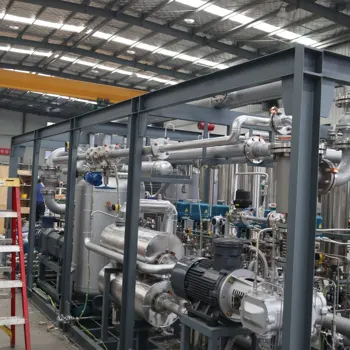
The use of acetone is mostly liquid, extraction, cleaning, point dispersion. The method is to collect in groups according to posts, the liquid distribution and extraction containers shall be sealed as much as possible, and the cleaning tank and wiping table shall be partially enclosed and negative pressure. In the design of the pipeline, attention should be paid to avoid parallel pipes with high-humidity gas. When water vapor enters the low-temperature section, frost will form, occupying cold capacity and increasing cleaning frequency.
The ventilation and collection system of the workshop should be well coordinated: if the overall ventilation volume is too large, the concentration of the collection point will be lowered, and the recovery efficiency of the low-temperature section will be reduced. The air volume balance between the two is worth carefully checking during the renovation.
The condensation of acetone usually requires two stages: the first stage is normal temperature or water cooling, and the high boiling point components and most of the water vapor in the mixed tail gas are collected first; In the second stage of low temperature section, the temperature level is pressed to the interval where acetone can effectively condense. For occasions with high intake air concentration and large processing capacity, a medium temperature precooling is added in front of the low temperature section to reduce the frosting speed of the low temperature section.
The heat exchange surface state of the low temperature section is the core of the operation: the efficiency drops rapidly after frosting, and the cleaning is arranged according to the change of pressure difference or recovery liquid volume, which is more suitable for the actual working conditions than according to the fixed cycle.
| Segment | Configuration considerations | Description |
|---|---|---|
| extraction with liquid | Vessel sealing operation is preferred | Reduce surface volatilization and open discharge |
| Cleaning Wipe | Local enclosure plus negative pressure | The hood opening is close to the liquid level, and the opening is as small as possible. |
| And tube | Avoid confluent with high humidity gas | When water vapor enters the low temperature section, frost will form and account for the cooling capacity. |
| condensation classification | The normal temperature level first collects the high boiling point and water vapor. | The low temperature section is specially responsible for acetone |
| Heat exchange surface cleaning | Triggered by differential pressure | Frosting in low temperature section is fast, arranged according to status |
| Recovery liquid treatment | Moisture detection, rectification on demand | Soluble with water, check water before reuse |
Acetone and water are completely miscible, and the recovery liquid is almost normal. When the reuse requirement is high, the water and light weight are separated by distillation; when the reuse requirement is low, simple dehydration is sufficient. The recovered liquid should be sealed for temporary storage, acetone is highly volatile, and the loss of open storage is considerable, which also brings safety problems.
The separation energy consumption of aqueous acetone has a great relationship with the concentration: the higher the collection concentration, the more the subsequent purification. Therefore, the closed source collection is not only a problem of waste gas treatment, but also directly affects the economy of recovery.
depends on the intake concentration. Acetone volatilizes quickly, the concentration is easy to be high under closed collection, and the effect and economy of condensation recovery after concentration are not bad. On the other hand, it is not cost-effective to recycle after dilution with large open air volume, and source collection is the key.
According to the reuse requirements: simple dehydration is enough when the requirements are low; When the requirements are high, the target concentration is raised by distillation. The cost of treatment has a great relationship with the water content, and the collection link controls the water vapor to enter the most economical.
First, the pre-cooling is sufficient to collect the water vapor and high boiling point components in the front stage, and the frosting speed in the low temperature section will naturally slow down. Then clean up according to the pressure difference to avoid invalid shutdown.
This article by LuoyangWohong PetrochemicalEquipment Co., Ltd. arranges that the company provides design, manufacturing and operation and maintenance services for condensation recovery, membrane separation recovery and complete solvent recovery devices for chemical and pharmaceutical enterprises. If you need process evaluation or scheme configuration, please contact and exchange.
Mr. Li 13526990215

Hotline





