
Methyl isobutyl ketone (MIBK) is a kind of medium boiling point ketone solvent commonly used in coating, extraction and cleaning process. Its boiling point is about 116 ℃, which is significantly higher than acetone and butanone, and its mutual solubility with water is very small. These two properties determine that its recovery route is relatively calm: the condensation temperature level does not need to be pressed too deep, and most of the first-stage normal temperature or water cooling temperature level can be condensed; The recovered liquid and water are easy to stratify, and the dehydration burden is light. The common practice is to collect in a closed manner and then recover by condensation, and decide whether to refine it or not according to the subsequent use.
The first is a medium to high boiling point. The boiling point of about 116 ℃ makes it have a considerable condensation ratio at the normal temperature and water cooling temperature. Only a small amount of residue needs to be processed in the cryogenic link, and the energy consumption structure of the whole system is relatively friendly. The second is that the volatilization rate is moderate, and the concentration of open environment is not as fast as that of low boiling point ketones, but the cumulative volatilization of long-term exposure is still considerable, and closed collection is still the first principle. The third is that it is often used as an extractant. Both the extraction phase and the raffinate phase carry solvents, and the source of tail gas is related to the intermediate materials of the process.
On the occasion of use, the exhaust gas in the spraying and drying of paint and ink has large air volume and low concentration. The exhaust gas from extraction and chemical synthesis processes has small air volume and high concentration. Equipment cleaning and barrel tank cleaning are intermittent high concentration emissions. The collection and recycling configuration of the three types of occasions should be treated separately.
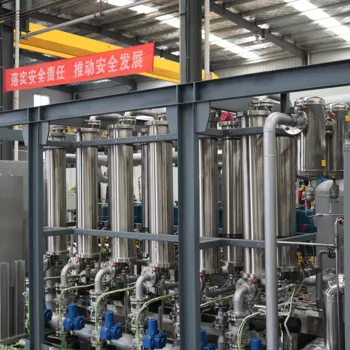
The exhaust gas collection of spraying and drying line is relatively ready-made: the oven exhaust and spray room exhaust can be connected to the main pipe, but the spray room has large air volume and low concentration. Whether to recycle separately depends on the concentration level. If the concentration is too low, it is more reasonable to concentrate and then recycle. The volatilization point of extraction and synthesis process is in the container breathing port, centrifugation and discharge port, and the method is closed operation and branch pipe collection, which is consistent with the routine of crystallization centrifugation process.
For the intermittent discharge of cleaning and bucket tank cleaning, it is advisable to set up an independent branch with air valve: open the valve for collection during operation, and close it after operation to keep the concentration of the main pipe. When multiple branches are merged, the total air volume shall be approved according to the simultaneous use coefficient to avoid excessive configuration of fans and condensing sections.
The condensation configuration of methyl isobutyl ketone is relatively calm: the first stage uses circulating water or normal temperature refrigerant to reduce the intake air to close to normal temperature, and most of the solvent condenses here; The second stage low temperature section collects the rest, and the temperature level does not need to be pressed very deep. Drying exhaust gas with high intake air temperature is precooled first, and the load and frosting speed in low temperature section will be obviously improved.
When the tail gas is mixed with low boiling point ketones such as acetone and butanone, it is classified according to boiling point: the first stage receives methyl isobutyl ketone first, and the low boiling point components are left to the low temperature stage. The recovered liquids at all levels are stored separately, and the quality is guaranteed. When aromatic hydrocarbons such as toluene and xylene are mixed, the boiling ranges of aromatic hydrocarbons and ketones are close to each other, so it is difficult to completely separate them in classification. If the recovered liquid mixture needs to be reused, unified refining treatment shall be arranged.
| Segment | Configuration considerations | Description |
|---|---|---|
| spraying and drying | Large air volume and low concentration, first evaluate concentration | Whether the exhaust gas of the spray room is recycled separately depends on the concentration level. |
| extraction synthesis | Closed container and branch pipe collection | Breathing port and discharge port are the main volatilization points |
| Clean the tank | Independent branch with air valve | Open the valve during operation, and close the valve to ensure concentration |
| condensation classification | The first stage normal temperature receiving main body | Residual in low temperature section, the temperature level need not be too deep |
| mixed ketone component | Classification by boiling point | The low boiling point ketone is left for the low temperature section, and the quality is guaranteed by storage. |
| Recovery liquid treatment | Static layered dehydration | Small miscibility with water, light dehydration burden |
Methyl isobutyl ketone and water miscibility is small, the condensate can be stratified after standing, the water phase is discharged or treated separately, and the organic phase can be used after moisture and purity are detected. This is its relative water-soluble solvents such as methanol and acetone. The biggest advantage. When the phase separation is incomplete, further dehydration is further dehydrated by distillation.
The recovery liquid temporary storage tank shall be kept airtight with a breather valve, and the anti-static grounding of the pipeline and storage tank shall be kept intact. The daily record of the amount of recovered liquid is the basis for judging the state of the system: when the input amount is stable and the recovery amount is declining, first check the state of the sealing and heat exchange surface of the collection point.
Its boiling point is medium to high, most of it can be collected at normal temperature, with small cryogenic load and friendly energy consumption structure. Dehydration with water layer saves complicated dehydration links, and the recovered liquid can be reused correspondingly. Comprehensive economy belongs to a more favorable category in ketone solvent. The specific value is recommended to be calculated according to the measured intake conditions.
The boiling point difference between the two is close to 60 ℃, and the conditions for graded condensation are very good: the first stage receives methyl isobutyl ketone at normal temperature and temperature, and acetone is left for the low temperature section, each independent liquid collection is measured, the recovered liquid is not mixed, and the treatment in the latter section is convenient.
Direct condensation is not cost-effective. When the concentration is too low, the load of the condensation section is large and the income is small. The common practice is to concentrate the concentration first and then condense it. Whether it is worth evaluating according to the measured data of air volume and concentration.
Extraction and other processes that are not sensitive to moisture can be used after layered dehydration and qualified detection. For applications with high purity requirements, refining shall be arranged according to the detection data, and the refining depth shall follow the detection.
This article by LuoyangWohong PetrochemicalEquipment Co., Ltd. arranges that the company provides design, manufacturing and operation and maintenance services for condensation recovery, membrane separation recovery and complete solvent recovery devices for chemical and pharmaceutical enterprises. If you need process evaluation or scheme configuration, please contact and exchange.
Mr. Li 13526990215

Hotline





