
Acetonitrile is a commonly used low boiling point solvent in pharmaceutical synthesis, extraction separation, and laboratory analysis. It has a boiling point of about 82 ℃, is miscible with water, and forms azeotropes. These two points determine the recycling strategy: the exhaust gas is first collected in a closed manner and then condensed to recover most of the acetonitrile; The recovered liquid cannot be dehydrated by static stratification, and distillation should be the main method. Deep dehydration should be combined with azeotropic distillation, extraction distillation, or adsorption dehydration. The recycling method of the recovered liquid is determined according to the purity requirements, and attention is paid to the hydrolysis characteristics of nitriles in acidic and alkaline environments throughout the process.
The first is low boiling point and fast volatilization. A high concentration of vapor can be formed in an open environment at room temperature. The main sources of acetonitrile waste gas include reaction feeding, extraction and layering discharge, centrifugal filtration, and vacuum pump exhaust, resulting in generally high tail gas concentrations. The second is flammable, with a low flash point. The tail gas collection and transportation process should be treated as flammable media, and fans, electrical equipment, and anti-static grounding cannot be omitted. The third is that it is miscible with water, and the condensate does not separate into layers when mixed with washing water, making it difficult to separate moisture.
Another point that is easily overlooked is that acetonitrile undergoes hydrolysis in water environments with acid or alkali present. If the recovered liquid is mixed with acidic or alkaline impurities and heated for a long time, the quality will significantly decline. So the recycled liquid should avoid cross contamination with acidic and alkaline materials, and those stored for a long time should be regularly tested.
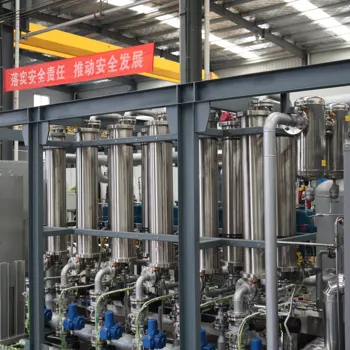
The replacement of the reaction kettle and the exhaust of the vacuum pump belong to high concentration intermittent sources, and it is advisable to set up separate branches for collection. The exhaust of the vacuum pump is first stabilized by a buffer tank before entering the condensation section to avoid the impact of pulse airflow on heat exchange. Extraction, centrifugation, filtration and other open operation points are continuous sources of volatilization. Local enclosures and directional ventilation are used to confine high concentration airflow inside the hood before introducing it into the main pipe. When multiple branches are merged, the air volume is determined based on the simultaneous use factor, and the pipeline maintains a slope and has a low point for drainage.
Before the exhaust enters the condensation section, if dust or liquid droplets are carried, filtration and foam removal should be carried out first to protect the heat exchange surface; The conveying pipeline and fan should be selected according to the requirements of flammable media, and the bridging and grounding should be kept intact.
Acetonitrile has a boiling point of about 82 ℃, slightly lower than most esters and ketones. The tail gas only needs to be cooled to room temperature and the water cooling temperature is not clean. To achieve a higher recovery rate, a lower temperature is required. Generally, two stages are arranged: the front stage is cooled by water or chilled water to reduce the temperature and load, and the rear stage is cooled by low-temperature refrigerant to condense residual steam as much as possible. The specific temperature level and recovery rate will be determined based on actual measurement data, and will not be based on estimates.
The condensed recovered liquid is a mixture of acetonitrile and water, without stratification, and dehydration requires distillation. Acetonitrile and water will form azeotropes, and it is difficult to continue dehydration when distilled to near the azeotropic composition. For deep dehydration, a new approach is needed: adding an entrainer for azeotropic distillation, using extraction distillation to change the relative volatility, or using adsorption dehydration as the end of distillation. Which route to choose depends on the purity requirements and processing capacity of the recycled liquid.
| Dehydration route | Applicable scenarios | Configuration considerations |
|---|---|---|
| Ordinary distillation | Preliminary dehydration | Due to azeotropic limitation, it cannot be removed to depth, serving as the preceding section |
| azeotropic distillation | Deep dehydration | Add entrainer, and arrange the entrainer recovery process together |
| extractive distillation | Deep dehydration | Changing the relative volatility, solvent selection and consumption need to be accounted for |
| Adsorption dehydration | Finishing after distillation | Suitable for applications requiring high purity, the adsorbent is periodically regenerated and replaced |
The recovered liquid is first filtered to remove impurities, then dehydrated by distillation, and then refined with high purity requirements. Reuse evaluation is divided into grades according to the purpose: cleaning and washing uses have loose requirements on moisture and chroma, and can be used after dehydration; Synthetic reaction, extraction and other uses are sensitive to purity and impurities, and the refining depth is arranged according to distillation range and impurity detection data. The recovered liquid shall be temporarily stored in a closed state and a breathing valve shall be left. The anti-static grounding shall be intact. The container shall be marked with the variety and testing status to avoid cross storage with acid and alkali materials.
The input volume and recovery volume are recorded on a daily basis in the ledger. When the recovery volume drops abnormally, first check the sealing of the collection point, the drift of condensation temperature and the scaling of the heat exchange surface, and then check the vacuum or pressure state of the distillation system.
Cannot. Acetonitrile and water are mutually soluble, and cannot be separated into layers upon standing. Dehydration depends on rectification. And because of the existence of azeotrope, ordinary rectification cannot be removed to the depth, and deep dehydration should be matched with azeotropic rectification, extractive distillation or adsorption dehydration.
The boiling point of acetonitrile is about 82 ℃, and only a part of acetonitrile can be condensed at the normal temperature water cooling temperature level. The residual steam can be finished by the post-stage low-temperature refrigerant. Only when the two stages are combined can a higher recovery rate be obtained and the refrigeration load can be balanced.
The effect is mainly on the quality of the recovered liquid: azeotropic limits the dehydration depth of ordinary distillation. It has little effect on cleaning purposes that are not sensitive to moisture; for sensitive purposes such as synthesis and extraction, additional dehydration means should be required according to purity requirements.
According to the purpose of the file: cleaning, washing purposes, filtration and dehydration qualified can be reused; synthesis reaction, extraction and other purity sensitive purposes, according to the distillation range and impurity detection data to determine the refining depth before reuse.
This article by LuoyangWohong PetrochemicalEquipment Co., Ltd. arranges that the company provides design, manufacturing and operation and maintenance services for condensation recovery, membrane separation recovery and complete solvent recovery devices for chemical and pharmaceutical enterprises. If you need process evaluation or scheme configuration, please contact and exchange.
Mr. Li 13526990215

Hotline





